
 guides
Fall Networking Season: Making the Most of Client Events
Make fall client events worthwhile by setting a relationship-focused goal, listening for ways to be genuinely useful, and recording enough context to remember each conversation. Afterward, deliver what you promised with a personal, relevant follow-up instead of sending the same pitch to everyone.
Fall Networking Season: Making the Most of Client Events
Fall brings conferences, association gatherings, client appreciation nights, and community events back onto busy calendars. The best way to make these events worthwhile is not to collect the most business cards. It is to have a few useful conversations, remember what mattered to each person, and follow through with something relevant. A simple plan before, during, and after an event can turn a crowded room into the beginning of stronger client relationships.
I learned this lesson in a very different setting while working on CBS MaxPreps high school sports coverage. I traveled across the East Coast and Midwest, meeting local publications and community figures so we could coordinate national coverage. Friday night games moved quickly, and I was often introduced to people on the field while carrying a camera and trying to keep track of who was who. A name alone was not enough. The school, city, role, and reason we had connected were the details that made a later conversation possible. Client events deserve the same attention to context.
What should I do before a client event?
Set a useful goal before you walk in. Choose a small number of people or types of conversation you hope to meet, and decide what would make the evening worthwhile beyond immediate sales. You might want to understand a client's upcoming priorities, reconnect with referral partners, or learn what challenges people in a local industry are facing.
Review the attendee or host information if it is available, but do not turn your preparation into a script. Look for a few natural conversation starters connected to the event, the person's work, or a shared interest. Bring a concise introduction that explains what you do in plain language, then be ready to ask questions and listen.
Make sure your contact-sharing method is ready before you arrive. If you use a digital business card, check that the link and QR code load correctly and that the page shows current information. Keep a paper option available if the room, lighting, or circumstances make phones awkward. If you want a refresher on the basics, see what to put on a digital business card.
Decide how you will capture context, too. A short note such as “Maya, introduced by Jordan, planning a client workshop in November” is far more useful than a bare name. Use a method you can manage discreetly, and avoid recording sensitive personal details that are not necessary to continue the relationship.
How do I make conversations feel natural?
Start with the shared setting, then give the other person room to shape the conversation. Ask what brought them to the event, what they are working on, or what they hope to learn. Listen for something specific you can respond to, rather than waiting for a pause to deliver your pitch.
A helpful introduction is brief and relevant. Instead of listing every service you offer, explain the problem you help solve and ask a question that makes it easy for the other person to share their perspective. If the conversation is not a fit, be gracious. A good event is not a contest to convert every attendee.
Look for ways to be useful before asking for anything. If someone mentions a resource, person, or question you can genuinely help with, offer it without attaching an expectation. You can introduce two people who should know each other, send a link you promised, or simply give an honest answer. Value-first behavior makes a follow-up feel like a continuation of the conversation, not a surprise sales sequence.
What information should I capture when I meet someone?
Capture only what will help you remember the person and honor the conversation. Usually that means their name, organization or role, how you met, the topic you discussed, and any next step you both agreed to. If they ask you to send something, note exactly what it is and when you said you would send it.
Ask before adding someone to a mailing list or ongoing marketing sequence. Sharing contact details at an event is not blanket consent for unrelated messages. Keep the exchange clear, use information responsibly, and follow the person's stated preferences.
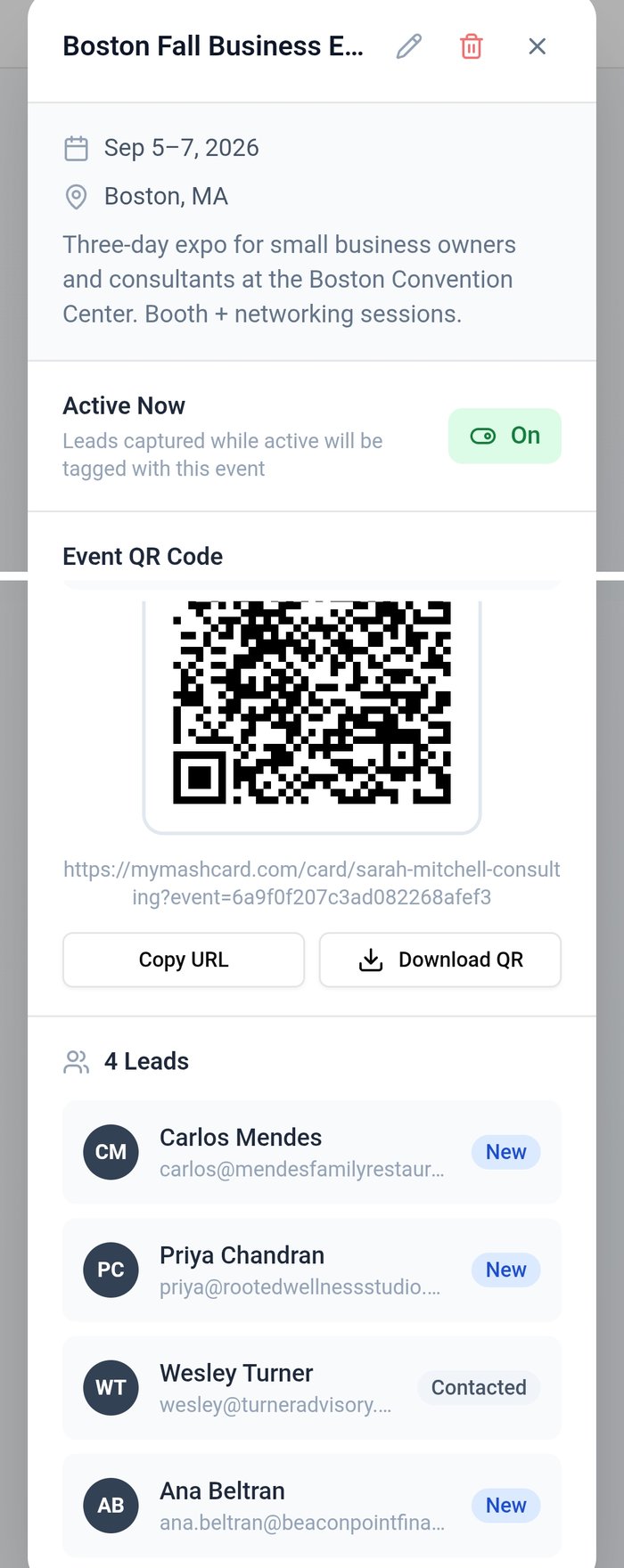
Digital tools can make exchanging details faster, especially when several people are networking at once, but the tool is secondary to the quality of the interaction. A QR code should be easy to find and scan, and a contact form should ask for only what is needed. MY MASH Card supports QR code and link sharing, not NFC hardware. Its digital business card with lead capture hub explains ways to make the exchange useful for both people.
How can I make a client event valuable without being pushy?
Treat the event as a chance to understand and help, not as a deadline to close a deal. Give the other person your attention, respect their time, and notice whether they want to continue the conversation. If they are busy or ready to move on, let them go warmly rather than forcing one more question or pitch.
Share something specific when it is genuinely relevant. A short introduction to a trusted contact, a practical resource, or a thoughtful answer can be more valuable than a generic promise to “circle back.” Do not manufacture urgency or imply that an event discount is the only reason to speak. Trust grows when your actions match what you said you would do.
A useful event measure is not just how many contacts you captured. Consider whether you had the conversations you intended, learned something about existing clients, and made commitments you can realistically keep. One thoughtful next step can matter more than a stack of unqualified names.
What should I do after the event?
Review your notes soon, while the conversations are still fresh. Add enough context to recognize each person and separate commitments from ideas. Prioritize promised resources, introductions, or answers first, then reach out to people who clearly expressed interest in continuing the conversation.
Keep the first message personal and specific. Remind them where you met, refer to the topic you discussed, and deliver the thing you promised. If there is a natural next step, make it easy to accept or decline. Avoid sending the same pitch to everyone you met, and do not disguise a mass message as a personal note.
Follow-up timing should fit the promise and the relationship. Send a resource when you said you would. For a casual new connection, a brief note within a few days can keep the conversation recognizable without demanding a response. For an established client, follow the pace and channel that already work for them. More guidance is available in how to follow up after networking without sounding salesy and the digital business card with follow-up hub.
If you manage several event conversations, organize them by event and next action so nothing gets lost. A follow-up reminder is a prompt for you to act, not a reason to send an automated message that ignores what the person actually said. Make room to pause when the contact is not interested or does not respond.
How can I get more from a series of fall events?
Treat the season as a relationship-building rhythm, not a string of isolated networking nights. Before each event, review the commitments and conversations from the last one. If you promised an introduction, complete it. If you learned that a client is preparing for a project, check in with a relevant resource rather than restarting with a generic “just checking in.”
After a few events, look for patterns. Which gatherings bring together the people you can genuinely help? Which conversations lead to meaningful collaboration, better client understanding, or useful referrals? Use those observations to choose where to spend your time, while remembering that a single slow event does not define the value of a relationship.
Keep boundaries clear. Do not use private client information as event conversation, and do not imply an endorsement or partnership that does not exist. Be transparent about what you offer, and make it easy for someone to say no or continue later.
Which digital business card tools should I consider?
Linq, HiHello, Popl, and Blinq each offer digital card products, and features can change. Compare them based on the workflow you actually need: how quickly someone can access your details, whether contact exchange feels comfortable, how you retain conversation context, and how you will follow through. Verify current product capabilities directly rather than relying on an old feature list.
For many client events, a digital card works best as one small part of a human process. It can make sharing details convenient, but it cannot replace listening, remembering what was discussed, or sending the promised introduction. If a simpler method is more appropriate for a particular room, use it.
The most successful fall event is not necessarily the one where you meet the most people. It is the one where the right conversations lead to a few honest, useful next steps. Prepare with intention, be generous with your attention, capture context respectfully, and follow through on what you promised. That is how a brief introduction can grow into a real client relationship.
What should you do?
- Best for
- Professionals and service business owners who attend seasonal client events and want to turn a few good conversations into durable relationships instead of a stack of forgotten contacts.
- Use this when
- Use this approach throughout the fall event season whenever you meet clients, referral partners, or prospects at conferences, appreciation nights, and community gatherings.
- Avoid if
- Do not add people to marketing lists without permission, oversell at social events, record unnecessary personal details, or send the same follow-up message to everyone you met.
- Alternatives
- A simple notes app and a personal card can work if you attend only a few events a year. A full CRM with automated sequences suits teams that need pipeline reporting. For most professionals who attend regular client events, a digital business card with context capture and follow-up reminders is the practical middle ground.
Stop letting connections go cold
My MASH Card captures who you meet, remembers the context, and helps you follow up before the opportunity disappears.


