
 follow-up
Best Practices for Following Up After Networking Events
The best networking follow-up is timely, personal, and useful. Contact people within one or two days, mention the specific conversation you had, deliver any promised resource or introduction, and offer a low-pressure next step only when it fits. Use reminders to protect your memory, but keep the message human and value-first.
Best Practices for Following Up After Networking Events
The best follow-up after a networking event is timely, personal, and useful. Reach out while the conversation is still fresh, mention something specific you discussed, and offer a relevant resource or next step before asking for a meeting. A good follow-up should make the other person glad they gave you their time, not feel like they entered a sales sequence.
Networking events create possibility, but the event itself rarely creates the relationship. The relationship starts when you remember the context, follow through on what you said, and give the other person a reason to continue the conversation. That takes a little organization, but it does not require a complicated automation system.
When should you follow up after a networking event?
Send a short first message within one or two days, while the details are still recognizable to both of you. If you promised a resource, introduction, answer, or link, send that first. The promise is more important than the perfect subject line.
A same-night message can work when the conversation was especially meaningful, but it can also feel automatic if all you write is "great meeting you." The next morning or following business day is usually a better balance. It gives you time to review your notes and write something that proves you were paying attention.
Timing should also reflect the setting. A quick exchange at a crowded conference may need a simple reminder of where you met. A long conversation over coffee deserves a more thoughtful note. The goal is not to follow a universal schedule. The goal is to continue the actual conversation.
What should you say in the first follow-up message?
Start with context, add one specific detail, and give something useful. Keep the message short enough to read on a phone.
A practical structure is:
- Remind them where you met.
- Mention the topic or problem you discussed.
- Share the promised resource, answer, or introduction.
- Suggest a low-pressure next step only if it makes sense.
For example:
"Hi Maya, it was good meeting you at the Boston Small Business Exchange. You mentioned that your team is rebuilding its referral process, so I am sending the checklist I mentioned. The section on tracking introductions may be useful. No need to schedule anything, but I would be interested to hear what you end up changing."
That message is better than a generic pitch because it respects the conversation. It also gives the recipient a useful reason to reply, even if a sales opportunity is not immediate.
If you did not promise anything, do not invent a reason to contact them. You can say what you enjoyed discussing and ask one genuine question. Value-first follow-up is not about disguising a pitch. It is about being honest about why you are continuing the conversation.
How do you follow up without sounding salesy?
Do not make the first message about what you want from the other person. Make it about the context you share and what might help them. That can be a useful article, an introduction, a relevant example, or a direct answer to a question they raised.
Avoid inflated compliments, urgency that does not exist, and vague phrases like "touching base." If you want to talk about your service, explain why it is relevant to what they told you. If there is no clear connection, wait until you have something genuinely useful to share.
The strongest follow-up often sounds less like marketing and more like a thoughtful continuation:
Helpful resource. Send the guide, checklist, example, or contact you promised.
Specific answer. If you did not know the answer at the event, look it up and come back with a clear response.
Useful introduction. Introduce two people only when you understand enough about both sides to make the connection worthwhile.
Honest next step. Ask whether they would like to compare notes, see an example, or continue the topic. Do not force a call simply because your calendar has openings.
My own trade show experience taught me why this matters. When I ran booths for HapYak, an electronic scanner could capture someone's contact information, but it could not capture the context around the conversation. Later, a list of names and email addresses did not tell me which person wanted a product demo, which person had a distribution idea, and which person simply stopped by to say hello. The missing context made every follow-up feel colder than the original conversation.
That is why I now think the note attached to a contact can matter as much as the contact itself. "Met at booth" is not enough. "Asked about using video to explain onboarding, send the customer story" gives you a useful path back into the conversation.
What should you write down at the event?
Capture three things before moving on: the person's name, the context of the conversation, and the next useful action. You do not need a full transcript. You need enough detail to recognize the relationship later.
Useful notes might include:
Context. Where did you meet, and what was happening around the conversation?
Priority. What problem, project, or interest did they mention?
Promise. Did you say you would send something, make an introduction, or answer a question?
Personal detail. Is there a non-sensitive detail that helps you write like a person rather than a database?
Timing. Did they mention a launch, hiring decision, event, or other timing signal?
If you use a digital business card, include the note as soon as you can. A QR code and shareable link can make exchanging information faster, but speed should support memory, not replace it. My MASH Card is designed around QR code and link sharing, not NFC hardware, so the useful part is the information and context you record after the exchange.
How can a digital business card help with event follow-up?
A digital card can reduce the friction of saving contact details, organizing people by event, and remembering which conversations deserve attention first. It should not turn every new connection into an automated campaign.
A digital business card follow-up system works best when it helps you sort real relationships into sensible next actions. One person may need a resource today. Another may be worth checking in with after their product launch. A third may simply belong in your professional network with no immediate ask.
My MASH Card's Lead Feed can help surface contacts that need attention without pretending that every nudge should become a message. A reminder is useful when it helps you keep a promise or revisit a meaningful conversation.
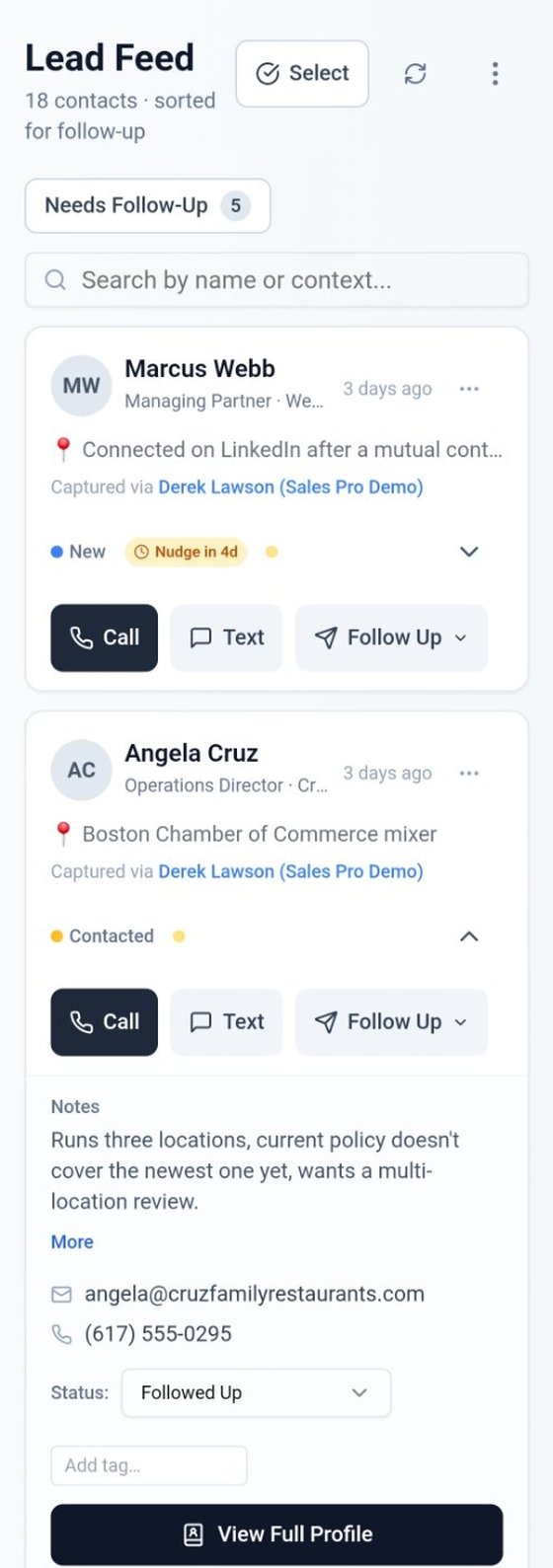
The system should support your judgment. You decide what the person needs, what would be helpful, and whether now is the right time. Technology can remind you, but it cannot manufacture relevance.
How many follow-up attempts are appropriate?
There is no magic number that makes persistence respectful. A few thoughtful attempts can be reasonable when each one has a clear purpose. Repeating the same "just checking in" message is not a strategy.
Try a simple sequence:
First message. Send the promised resource or a specific reminder of the conversation.
Second message. Share a new piece of value or answer a related question, usually several days later.
Final light touch. Leave the door open without pressure. Tell them you would be glad to reconnect if the topic becomes timely.
After that, stop pursuing the reply. Someone can be a valuable contact even if the timing was wrong. Keep the relationship organized, but do not treat silence as an objection that must be overcome.
Should you automate follow-up after networking?
Automate reminders and organization, not the relationship itself. A reminder to review your notes is helpful. A generic message sent to everyone you met can damage trust faster than no message at all.
Tools such as Linq, HiHello, Popl, and Blinq can help people share professional information, but the platform is not the follow-up strategy. The important questions are whether you recorded useful context, whether the message matches the conversation, and whether you are offering something worthwhile.
Automation is most useful for the parts people reliably forget: creating a task, grouping contacts by event, setting a future reminder, or keeping a promise visible. It is less useful when it removes the judgment that makes a message personal.
What if you forgot to follow up for weeks?
Do not pretend the delay did not happen, and do not over-explain it. Reopen the conversation with a real reason.
"Hi Jordan, we met at the New England Startup Forum and talked about referral partnerships. I came across this example and thought of that conversation. It is a practical look at the issue we discussed. I hope your launch went well."
If you promised something and failed to send it, acknowledge that directly: "I said I would send this and missed the follow-up. Here it is now." A short honest apology is better than a polished excuse.
How do you know whether a follow-up worked?
A successful follow-up does not always produce a meeting or a sale. It may clarify that there is no fit, create a useful introduction, answer a question, or simply make it easier to reconnect later.
Track the quality of the next interaction, not only the number of replies. Did the person respond with more context? Did they use the resource? Did you learn what they actually need? Did the conversation become more specific?
For a deeper system, compare your process with how to build a follow-up system that actually works and how to follow up after networking without sounding salesy. If the event involved collecting contact details, how to capture leads at networking events covers the handoff from exchange to organized record.
A networking event gives you a moment of attention. The follow-up is where you show whether you deserved it. Remember the details, deliver what you promised, and make the next interaction useful. That is the part people remember, and it is the part no automation can do for you.
What should you do?
- Best for
- Professionals, founders, salespeople, service businesses, consultants, and anyone who wants to turn event conversations into respectful long-term relationships.
- Use this when
- Use this approach after a conference, trade show, meetup, or professional introduction when you want to continue a real conversation without sounding like a generic sales sequence.
- Avoid if
- Avoid generic check-ins, exaggerated compliments, repeated messages with no new value, and automated pitches that ignore the context of the event.
- Alternatives
- If there was no meaningful conversation or clear reason to reconnect, save the contact for future networking instead of forcing an immediate follow-up.
Tags
Stop letting connections go cold
My MASH Card captures who you meet, remembers the context, and helps you follow up before the opportunity disappears.


