
 comparisons
Digital Business Cards vs LinkedIn: Which Actually Converts?
LinkedIn is best for public credibility, professional discovery, and long-term networking, while a digital business card is better for converting a real conversation into a direct next step. Use LinkedIn as your public proof and a digital card as the focused handoff that helps someone save your details, request a resource, or continue the relationship.
Digital Business Cards vs LinkedIn: Which Actually Converts?
If your goal is to build a professional relationship after a real conversation, a digital business card usually converts better than sending someone to LinkedIn. LinkedIn is excellent for public credibility, discovery, and long-term networking. A digital business card gives a person a focused next step, your contact details, your offer, and a clearer reason to stay connected. The strongest approach is not choosing one forever. Use LinkedIn as proof and reach, then use a digital business card to make the personal connection easier to continue.
What is the real difference between a digital business card and LinkedIn?
A digital business card is a focused contact-sharing destination. It can include your name, role, phone number, email, website, social links, booking link, QR code, and a prompt to save or share your information. It is designed for a specific moment: someone has met you, scanned your QR code, clicked your link, or asked how to reach you.
LinkedIn is a professional network. Your profile can show your work history, recommendations, posts, connections, interests, and broader professional identity. It is designed for discovery and ongoing public interaction, not necessarily for a quick exchange at a conference, coffee shop, job site, or client meeting.
That difference matters because conversion depends on intent. A person who is already talking with you should not have to search your name, pick the right profile, and navigate a busy feed just to find your email address. A person who has never met you may benefit from seeing your LinkedIn profile before deciding whether to connect.
Which one converts better after an in-person conversation?
A digital business card is usually the better conversion tool after an in-person conversation because it reduces friction. You can share one QR code or link, and the other person immediately sees the information that helps them take the next step. LinkedIn can support the relationship, but it should not have to carry the entire handoff.
I learned this lesson in a very unglamorous way while running AdamHelper, my moving and labor service. Customers would sometimes text weeks after a quote, and I had no reliable record of the conversation or the details we had discussed. I also met real estate agents through customer moves. We exchanged cards, said we should stay in touch, and then neither of us followed up. The problem was not a lack of LinkedIn profiles. The problem was that the connection had no useful, memorable next step.
A focused digital business card cannot create trust by itself. It can make the trusted handoff easier. That is where conversion begins.
Is LinkedIn better for building credibility?
Yes. LinkedIn is generally better for credibility at a distance. Someone researching you can see your experience, recommendations, posts, mutual connections, and professional interests in one familiar place. That context can be valuable before a sales call, speaking invitation, partnership conversation, or job interview.
LinkedIn also gives you distribution. A useful post can reach people who were not in the room when you met. If you share practical advice, answer questions honestly, and make thoughtful introductions, your profile becomes evidence of how you work.
But credibility is not the same as conversion. A polished profile may convince someone that you are legitimate, while a direct contact page helps them decide what to do next. Treat LinkedIn as the public layer of your professional identity, not as a replacement for every point-of-contact experience.
If you want to improve the public layer, start with what to put on a digital business card and make sure the information people see is consistent across your profile, website, and card.
What does a digital business card do that LinkedIn does not?
A digital business card gives you control over the moment. Instead of asking a new contact to browse a social network, you can present only the details that matter for the relationship you are beginning.
A clear next action. Your card can send someone to book a conversation, visit your website, save your contact information, or request a resource. LinkedIn offers connection and message actions, but the surrounding feed competes for attention.
A focused identity. A card can be written for your role and audience. A real estate agent can emphasize service areas and referral information. A consultant can lead with a useful guide. A contractor can show service categories and a call option.
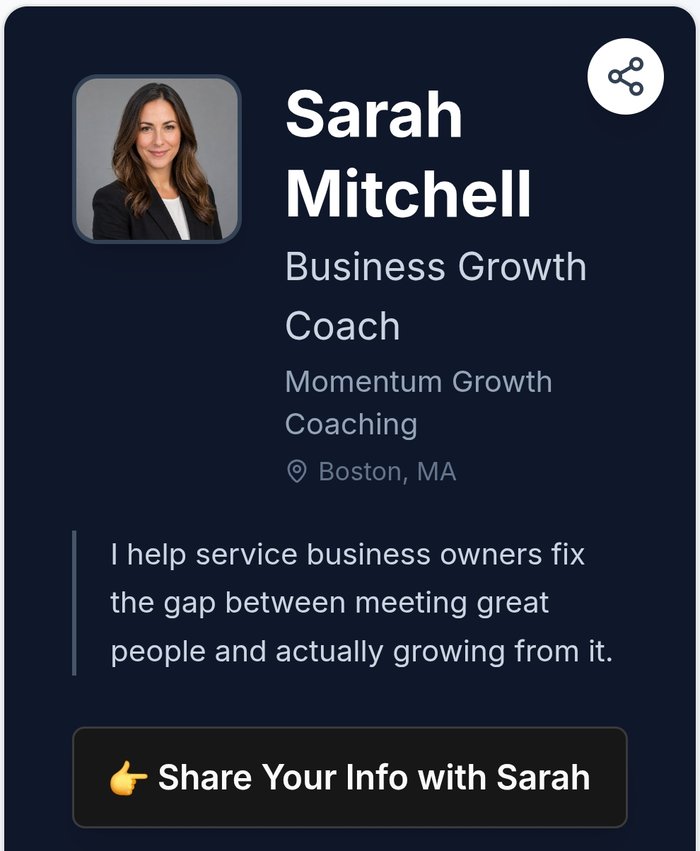
A more direct handoff. The person you met can save or share your details without searching for the right profile. This is especially useful when your name is common or when the other person is busy.
Lead capture and context. When appropriate, a card can support a digital business card with lead capture approach. The value is not collecting every possible detail. The value is giving someone a useful reason to identify themselves, such as receiving a checklist, quote, resource, or follow-up answer they requested.
LinkedIn remains useful for all the things a focused card is not: public conversation, social proof, professional discovery, and relationship maintenance at scale.
Can you use both without annoying people?
Yes, if you give each tool a different job. The mistake is asking a new contact to complete several identical actions at once: scan your card, connect on LinkedIn, subscribe to an email list, book time, and follow every social account. That feels like homework.
Instead, offer one helpful next step first. If someone asks for your information, share your digital card. If the conversation is about your work, let the card answer the obvious questions. If LinkedIn would genuinely help them see your background or keep up with your ideas, mention it as an optional second step.
The principle I use is value before the ask. If I meet a real estate agent, I might offer a useful local contact, a moving checklist, or an honest answer about a customer problem before requesting a referral. A connection is not a lead just because you captured a name. It becomes a relationship when you are useful and remember the context.
After the meeting, use a simple follow-up system that actually works. Record what the person cared about, send the promised resource, and make the next message specific. “Great meeting you” is less valuable than “Here is the vendor list I mentioned for your renovation clients.”
How do Linq, HiHello, Popl, and Blinq fit into this comparison?
Linq, HiHello, Popl, and Blinq are digital business card products, while LinkedIn is a professional network. Comparing them directly as if they solve the same problem can lead to a bad buying decision.
Digital card platforms. Products such as Linq, HiHello, Popl, and Blinq focus on sharing a profile or contact page through a link, QR code, or related sharing method. Their differences can include branding, analytics, team controls, contact capture, templates, and integrations. Check the current feature set and pricing before choosing one.
LinkedIn. LinkedIn focuses on profiles, connections, content, search, messaging, and professional identity. It is valuable for visibility and trust, but it is not designed to be a neutral, distraction-free contact page for every face-to-face exchange.
MY MASH Card. MY MASH Card is built around simple QR code and link sharing, with a focused profile and practical next steps. It does not require NFC hardware. The question is not whether it replaces LinkedIn. The question is whether it gives the person in front of you a better way to remember, contact, and helpfully re-engage with you.
The right comparison is outcome-based. Do you need public professional visibility, a direct contact handoff, lead capture, follow-up context, or some combination? Name that job before comparing feature lists.
When should you share LinkedIn instead of a digital business card?
Share LinkedIn first when the person wants to see your work history, read your ideas, verify mutual connections, or follow your ongoing professional content. It is also a good fit when the relationship is primarily peer networking and there is no immediate service, resource, or contact detail to exchange.
Share a digital business card first when the person asks for your phone number, email, website, booking link, pricing information, or a way to save your details. It is also the better fit at a busy event where someone needs a quick, memorable handoff and you do not want them searching through a social feed.
Use both when the relationship has two distinct needs. Your card handles the immediate handoff. LinkedIn gives the person a fuller view of your professional work over time.
What should you measure if you care about conversion?
Start with the action you actually want. If it is a saved contact, measure saves or direct replies. If it is a consultation, measure qualified booking requests. If it is a referral relationship, measure useful conversations and introductions, not just profile views.
For LinkedIn, look at meaningful profile visits, connection acceptance, replies, and conversations that continue beyond a greeting. For a digital business card, look at page visits, link clicks, contact exchanges, lead submissions where relevant, and follow-up outcomes.
Do not treat every click as business value. A hundred curious visits may be less useful than five people who received the resource they asked for and replied with a real question. Conversion is not merely attention. It is movement toward a mutually useful relationship.
What is the practical decision?
Choose LinkedIn as your public professional identity and discovery channel. Choose a digital business card as your direct, focused handoff after a conversation. If you can use only one today, use the tool that matches the moment: LinkedIn for being found and evaluated, a digital card for being remembered and contacted.
My recommendation for most professionals is simple: keep your LinkedIn profile complete, but do not make every new contact hunt for it. Give people a clear digital card, make the next step useful, and follow through on what you said you would send. That combination converts better because it respects attention and gives the relationship somewhere practical to go.
What should you do?
- Best for
- Professionals, service businesses, consultants, salespeople, and event networkers who need both public credibility and a low-friction way to continue one-to-one conversations.
- Use this when
- Use a digital business card after an in-person conversation when someone needs a focused way to save your contact details, visit your website, request a resource, or take a clear next step.
- Avoid if
- Do not make people search a social feed for basic contact information, ask for multiple actions at once, or measure conversion by clicks alone. Avoid treating a captured contact as a relationship before you have been useful.
- Alternatives
- Use LinkedIn when the person wants to evaluate your professional background, follow your content, or connect through a broader professional network. Using both is often best when each has a distinct job.
Stop letting connections go cold
My MASH Card captures who you meet, remembers the context, and helps you follow up before the opportunity disappears.


