
 follow-up
How to Build a Follow-Up System That Actually Works
A follow-up system works when every new contact gets a clear record, owner, next action, and date. Keep the stages simple, capture conversation context, use personal templates without sounding robotic, and review overdue tasks regularly so promising introductions do not disappear.
How to Build a Follow-Up System That Actually Works
Good conversations create possibilities, but possibilities are easy to lose. You meet someone at an event, promise to send a resource, exchange contact details, and then return to a busy week.
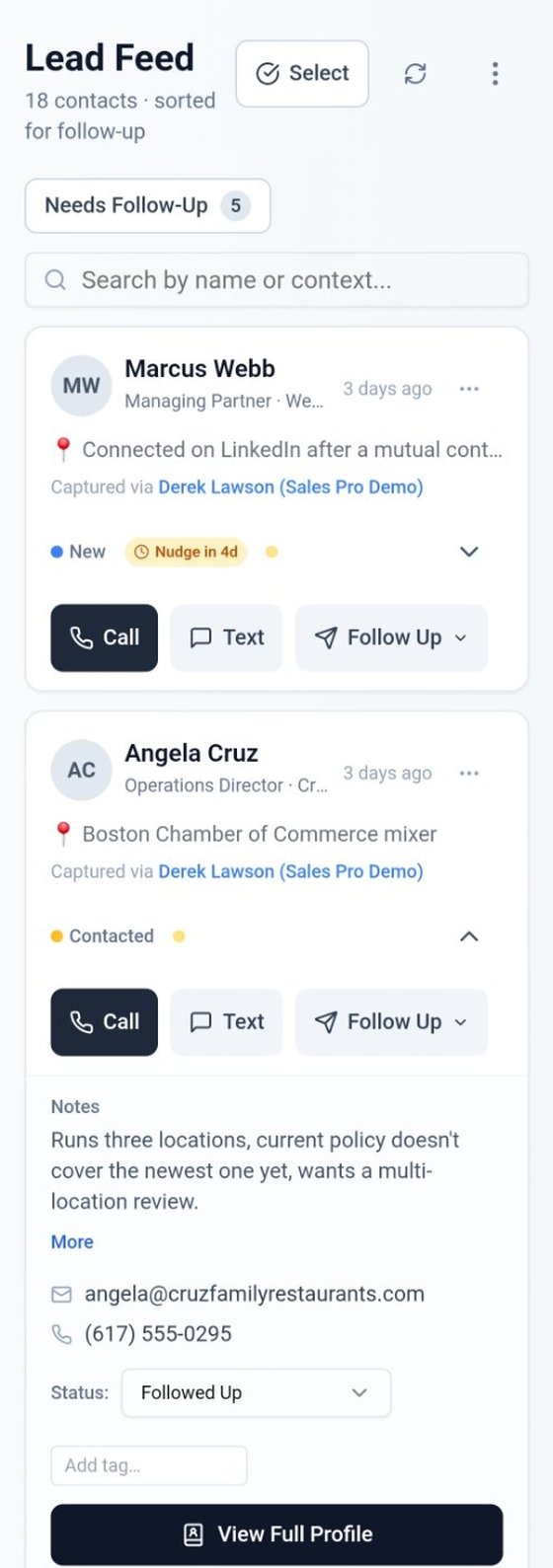
A follow-up system keeps that promise visible. It does not need to be complicated. The best system gives every contact enough context to remember the conversation, a clear next action, and a date for doing it. That is exactly what a digital business card with follow-up provides.
Start With the Conversation, Not the Pipeline
A follow-up record should help you answer five questions:
- Who did you meet?
- Where and when did you meet them?
- What did you discuss?
- Why might a continued conversation be useful?
- What did either of you agree to do next?
This information is more valuable than a bare name and email address. A note such as “met at the August services meetup, interested in organizing referral leads, send the tracking checklist” gives you a natural starting point for your message.
If you use a digital business card, capture this context immediately after the interaction. The few minutes you spend writing it down can save you from trying to reconstruct the conversation later.
Choose a Small Number of Stages
A simple system might use five stages:
New. You have the contact, but no follow-up has been sent.
Contacted. You sent a message and are waiting for a response.
In conversation. The person replied and there is an active exchange.
Next step scheduled. A call, introduction, resource, or other action has been agreed on.
Closed or nurture. The immediate conversation is complete, or the timing is not right.
The labels can vary. What matters is that each stage tells you what to do next. Avoid building a system with so many categories that updating it becomes work nobody wants to do.
Give Every Contact a Next Action
“Follow up soon” is not a next action. It is a vague intention that can sit untouched for weeks.
Write the next step as a small, observable task: send the article, ask whether the hiring project is still active, introduce them to a relevant contact, or suggest two times for a call.
Add a date and an owner. Even if you work alone, naming the owner matters because it turns a general hope into a responsibility. If the action is not finished by the date, it should be easy to spot and reschedule.
Use Templates Without Sounding Robotic
Templates save time when they provide structure, not when they replace judgment. Build a few flexible outlines for common situations:
Resource follow-up: remind the person where you met, mention the topic, and send the resource you promised.
Conversation follow-up: refer to one specific detail and ask a useful question that is easy to answer.
Referral follow-up: explain who introduced you, say why the connection may be relevant, and give the person a low-pressure way to respond.
Personalize the first two sentences. One accurate detail makes a message feel connected to the original conversation. A long paragraph of generic enthusiasm usually does the opposite.
Set a Practical Rhythm
For a warm introduction, send the first message within a day or two. If the person does not reply, send one helpful reminder several days later. Then pause instead of creating an endless sequence.
The right rhythm depends on what you discussed. A promised resource should be delivered promptly. A potential partnership may deserve more space. Your notes should record the reason for the next message so that every touch has a purpose.
Keep a last-contact date and a next-contact date. Those two fields prevent both neglect and accidental over-messaging.
Review the System Weekly
A short weekly review is enough for most solo professionals and small teams. Look for overdue actions, contacts waiting for a response, and conversations that need a decision.
Ask three questions:
- Which follow-ups are most important this week?
- Which records are missing context or a clear next action?
- Which sources are creating worthwhile conversations?
Use the review to clean up the system, not to collect more data. If a field is never used, remove it. If a stage does not change what you do, simplify it.
Measure Progress Beyond Replies
Replies matter, but they are not the only useful result. Track whether follow-up leads to a meeting, referral, useful introduction, proposal, or a clear “not now.”
This helps you improve the process without treating every contact as a conversion opportunity. A channel that produces fewer contacts but better conversations may be more valuable than one that produces constant activity.
You can also measure speed. How long does it take for a new contact to receive a thoughtful first message? Faster is not always better, but a consistent delay often signals that the system needs a clearer owner or simpler workflow.
The Bottom Line
A follow-up system should make good intentions easier to act on. Capture the context, keep the stages simple, define one next action, assign a date, and review the list regularly.
Use templates for structure, but keep the message personal. Track meaningful outcomes instead of chasing activity.
The goal is not to turn every introduction into a sales sequence. It is to make sure valuable conversations receive the attention you intended to give them.
What should you do?
- Best for
- Solo professionals and small teams Salespeople and service providers People who generate leads through conversations Anyone building a consistent referral or networking process
- Use this when
- You collect contacts from networking, referrals, events, or digital business card forms You often remember a conversation but forget the next step Your follow-up depends on scattered notes, inbox searches, or memory You want a repeatable process without adopting a complicated CRM
- Avoid if
- Creating too many pipeline stages before you know what you need Treating every contact like a sales-ready prospect Sending generic messages with no connection to the original conversation Leaving next steps without a date or clear owner
- Alternatives
- [How to track digital business card leads](/how-to-track-digital-business-card-leads) - organize contact context [How to follow up after a networking event](/how-to-follow-up-after-a-networking-event) - write the first message [How to capture leads at networking events](/how-to-capture-leads-at-networking-events) - collect better information
Stop letting connections go cold
My MASH Card captures who you meet, remembers the context, and helps you follow up before the opportunity disappears.


