
 lead-capture
How to Get More Reviews with Your Digital Business Card
Real estate agents can use a digital business card to make an honest review request easier by linking directly to the correct review page and sharing it at a natural moment after a successful client milestone. Keep the invitation personal, optional, and pressure-free, and remember that a card can simplify the process but cannot guarantee a review.
How to Get More Reviews with Your Digital Business Card
A happy client may be willing to recommend you, but that does not mean they will remember where to leave a review later. The best approach is to make the next step simple, personal, and well timed. A digital business card can help by giving you one easy-to-share place for your contact details and a direct path to your review page, so you can invite feedback while the good experience is still fresh.
For real estate agents, reviews help future clients understand what it is like to work with you. They are not a substitute for doing good work, and they should never be pressured or traded for a reward. Think of the card as a useful handoff, not a review machine: give your client a clear way to find you again, then make an honest request when the moment is right.
Why does timing matter more than sending lots of reminders?
Ask when a real milestone has just gone well, such as a smooth closing, a successful move-in, or a problem you helped resolve. Your client can then recall specific details rather than trying to reconstruct the whole experience weeks later. One thoughtful invitation is usually more respectful than a string of generic messages.
I learned how easily a useful connection can get lost after a job is done. Through AdamHelper, my moving and labor service, I met real estate agents through customer moves. We exchanged cards, but neither side followed up. That experience stuck with me: sharing contact details is only the beginning. A timely, relevant next step matters, and it should be genuinely useful to the person receiving it.
A review request deserves the same care. Do not interrupt a client during a stressful part of a transaction or ask them to write something while they are still dealing with an unresolved issue. First make sure the experience is complete, address any concern, and then ask whether they would be comfortable sharing honest feedback.
What should a realtor's review request card include?
Keep the card focused on what a client needs to identify you and take the next step. Include your name, professional role, brokerage details where appropriate, reliable contact options, and a clear link or button to the correct review destination. A QR code can make it convenient to open the card in person, while a link makes it easy to send it in a text or email afterward.
In My MASH Card, the Realtor Review Card template is designed around a Google review request. A dedicated review card reduces the friction of finding the right destination again. Before sharing it, verify that the link opens the intended business profile and that the card's details are current.
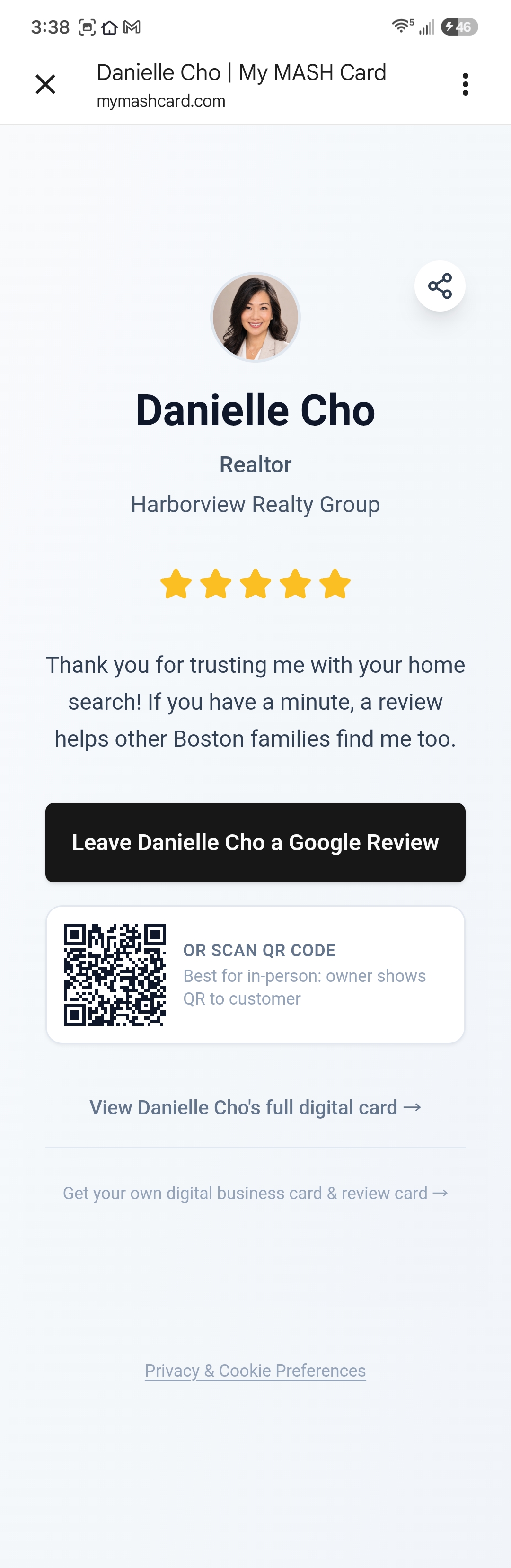
A focused card also gives you a natural way to say, “Here is my contact information, and if you have a moment, this is where you can leave an honest review.” Avoid burying the request among unrelated promotions, multiple competing links, or a long explanation. Your client should immediately understand what the link does and that leaving feedback is optional.
How do I ask without making a client feel pressured?
Be direct, appreciative, and clear that you welcome honest feedback. For example:
“Thank you for trusting me with your move. If you’re comfortable sharing your experience, this link goes to my review page. Honest feedback helps future clients know what working together is like. No pressure at all.”
Personalize the note with a detail that is true and helpful, such as the home you helped them find or a resource you promised to send. Do not use fake familiarity or a canned paragraph that could have gone to anyone. If you have promised a neighborhood guide, contractor introduction, or answer to a lingering question, deliver that first. A review invitation should not replace the service you owe.
Value-first communication matters especially in real estate. The relationship does not end at closing, and you do not want every later message to feel like an attempt to harvest praise. Be useful when you can, stay available, and make the request a small, optional invitation rather than the price of your attention.
How can I share the review link in person and later?
At a closing or another natural point of contact, open your digital card and let the client scan its QR code or send them the direct link. Explain what they will see before they open it. If you are following up remotely, send the review link directly in the message as well as your card, so the client does not have to search through the card to find the action.
The card is useful as a reliable home for your professional identity and contact information. It does not make the request for you, determine whether a client is satisfied, or guarantee that a review will be written. The human moment still matters: choose a reasonable time, ask clearly, and accept either answer graciously.
To build a broader process for collecting contact details ethically and keeping track of conversations, see the digital business card lead capture guide. For more ways to make your card useful after the first exchange, read How to Use Digital Business Cards to Generate More Referrals and Digital Business Cards for Real Estate Agents.
Should I offer a gift or discount for a review?
Do not make a review conditional on a reward, and do not ask for a positive review specifically. Incentives can undermine trust and may violate the review platform's rules. Your request should be for an honest account of the client's experience, whether that account is glowing, mixed, or critical.
If a client raises a concern, listen and try to resolve it through the proper channel. Do not ask them to remove or change a review in exchange for fixing a problem. Separating service recovery from public feedback is more respectful and helps keep your reputation grounded in real experiences.
Also avoid asking only clients you already expect to praise you while discouraging others from sharing feedback. Follow the relevant platform's policies and applicable brokerage guidance, and use the same neutral invitation consistently. A professional reputation is built by the quality of the work and how you respond when something does not go perfectly.
What should I do after sending the request?
Give the client space. If they do not respond, do not assume they are unhappy, and do not keep nudging them. They may be busy, prefer not to post publicly, or simply have forgotten. One polite reminder after a reasonable interval can be appropriate if your relationship and platform rules allow it, but repeated asks can make a warm relationship feel transactional.
Thank clients who do leave feedback, without asking them to edit it or promising special treatment. If a review is public, reply professionally and protect the client's privacy. Never disclose transaction details or personal information in a public response. For a critical review, acknowledge the concern calmly and offer an appropriate private channel to discuss it.
How do I know whether the card is helping?
Look for practical signals, not just a raw count of reviews. Notice whether clients can find your contact details, whether they reach the right review page, and whether the request feels natural in your follow-up. Ask clients if anything about the process was confusing. If the link is wrong, the card is outdated, or the message feels awkward, fix that before sending more requests.
You can also keep a lightweight record of when you shared the card and whether you completed any promised follow-up. Do not store more client information than you need, and use a system that fits your brokerage's privacy and recordkeeping requirements. A simple, respectful process is better than an elaborate campaign that puts pressure on former clients.
Is a digital business card enough to earn more reviews?
No. It can make the request easier to act on, but it cannot create a positive client experience or guarantee a public review. Tools such as Linq, HiHello, Popl, and Blinq also offer digital ways to share professional information, so compare the options based on the workflows you actually need. For this use case, confirm that you can direct a client to the correct review destination and share the card in the ways you prefer. My MASH Card supports QR code and link sharing, not NFC hardware.
The most dependable process is simple: serve the client well, resolve any open issue, ask for honest feedback at a natural moment, and make the route to your review page easy to reach. A well-designed digital card supports that process. The relationship and the quality of your work remain the reason anyone would want to recommend you.
What is the simplest review-request workflow for an agent?
Prepare your review card before you need it. Test the link from a phone, make sure your name and brokerage details are accurate, and save a short request that sounds like you. After a successful client milestone, deliver any promised resource, share your card or direct review link, and invite honest feedback without pressure. Then let the client decide.
Keep the interaction human. The point is not to turn every closing into a conversion opportunity. It is to make it easy for a satisfied client to share useful feedback if they choose, while staying available whether or not they do.
What should you do?
- Best for
- Real estate agents and other service professionals who want an easy, respectful way for satisfied clients to find their review page.
- Use this when
- Use a review card after a client milestone has gone well, open issues are resolved, and an honest review request feels appropriate.
- Avoid if
- Do not offer rewards for reviews, demand positive feedback, repeatedly pressure clients, or share an untested or incorrect link.
- Alternatives
- Share the direct review-page link in a personal text or email, or provide a printed card with a QR code if that better suits the client.
Stop letting connections go cold
My MASH Card captures who you meet, remembers the context, and helps you follow up before the opportunity disappears.


