
 lead-capture
How to Track and Manage Your Networking Leads Effectively
Track networking leads by recording the conversation context, the person's need, one useful next action, and a realistic review date. Use simple stages such as New, Needs follow-up, Nurture, and Closed, then review active leads weekly so value-first follow-up does not get lost.
How to Track and Manage Your Networking Leads Effectively
The best way to track networking leads is to record the context of each conversation, assign one useful next step, and review your list on a consistent schedule. A name and phone number are not a lead management system. A useful system tells you who the person is, what they care about, how you can help, and when it makes sense to reach out.
I have lost good opportunities by treating a pocket full of business cards like a plan. The contacts were real, the conversations were promising, and the follow-up still never happened because I had no reliable way to remember what mattered.
What information should you record after meeting someone?
Record enough information to make the next conversation feel personal, not so much that entering a contact becomes another project. At minimum, capture the person's name, contact details, where you met, the topic you discussed, the problem or goal they mentioned, and the next action you agreed to take.
I use a simple five-part note:
- Context. Where did we meet, and what was happening?
- Need. What problem, goal, or question did they mention?
- Fit. Why might my work, product, or network be useful?
- Promise. What did I say I would send, answer, or introduce?
- Next step. What should happen next, and when?
That structure is more useful than a generic label such as "conference contact." It gives you a reason to reconnect and protects the other person from receiving a message that ignores the conversation you actually had.
How do you capture networking leads quickly?
Capture the contact as close to the conversation as possible, then add the context before the day gets crowded. A digital business card can make the first part easier by giving someone one link to your contact details and providing a clear way to continue the interaction. For a deeper look at the capture side, see how digital business cards capture leads.
The capture method matters less than the handoff into your system. If a scanned contact, form submission, or shared profile sits in a separate place that you never review, it is only a new version of the business-card pile.
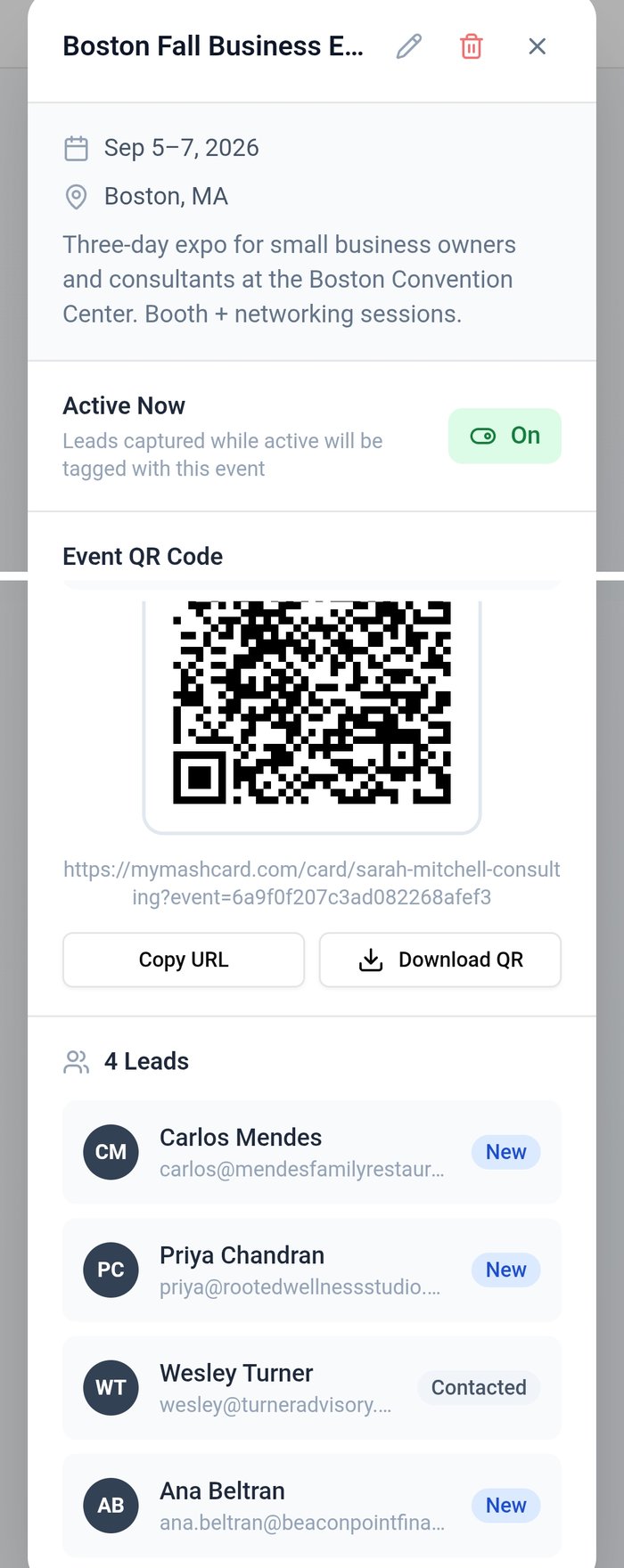
For event-based networking, I like organizing contacts by event or source. That gives the lead a little more context automatically and makes it easier to remember the setting when you follow up later.
What is the simplest networking lead tracking system?
Start with four stages: New, Needs follow-up, Nurture, and Closed or not a fit. These labels do not need to represent your entire sales process. They only need to make the next decision clear.
A new contact still needs context or an initial message. A lead that needs follow-up has a specific action and timing. A nurture contact has a real relationship or possible future need, but there is no immediate reason to ask for a sales conversation. Closed or not a fit keeps old contacts from cluttering your active list.
Within each stage, add one next-action date. Avoid creating ten custom statuses before you have used the system for a month. The goal is not to make your tracker impressive. The goal is to make it difficult for a useful promise to disappear.
A spreadsheet can work for a solo professional with a modest number of contacts. A CRM can make more sense when several people need access, leads arrive from multiple sources, or you need reporting. My MASH Card can support the early capture and organization layer, while your existing CRM can remain the place for a larger sales process.
How should you prioritize networking leads?
Prioritize based on relevance, timing, and permission to continue, not just on how enthusiastic the conversation felt. I use three practical questions:
- Is there a real need? Did the person describe a problem, goal, project, or decision?
- Can I be useful? Do I have a relevant answer, resource, introduction, or experience?
- Is there a clear reason to act now? Did they mention a deadline, upcoming event, hiring need, move, launch, or other timing cue?
A contact with a strong need but no immediate timing may belong in nurture. A contact with a clear deadline but no relevant fit should not be forced into your active pipeline. Good prioritization protects your time and makes your outreach more respectful.
You can also use a simple priority label such as high, medium, or nurture. Keep the criteria consistent. "High" should mean something you can explain, not simply someone you enjoyed meeting.
How often should you review your networking leads?
Review new contacts within 24 to 48 hours, then set a weekly review for active follow-ups. The first review is about accuracy: fix names, add context, and deliver anything you promised. The weekly review is about action: send the resource, make the introduction, answer the question, or update the timing.
A monthly review helps with nurture contacts. Look for a genuine reason to reconnect, such as a relevant article, a useful introduction, or an update related to the problem they mentioned. Do not send a generic "just checking in" message simply to move a row in your tracker.
For more on making that next message useful, learn how to follow up after a networking event. The best follow-up is usually a continuation of the original conversation, not a reset into a cold pitch.
What did trade shows teach me about tracking leads?
When I ran trade show booths for HapYak, an enterprise video platform, electronic scanners made it easy to collect contact records. The harder problem was context. A scanner could tell us that someone stopped by, but it could not always tell us whether they cared about onboarding, video engagement, internal training, or a specific customer problem.
After a busy show, the list looked valuable because it was large. In practice, the most useful contacts were the ones with a note about the question they asked or the use case they described. Without that detail, the follow-up team had to guess, and guessed-at outreach rarely feels personal.
That experience changed how I think about lead tracking. The system should preserve human observations, not just automate the collection of names. If your tool captures a contact but loses the reason the conversation mattered, you still have work to do.
What should you do with a lead after the first follow-up?
Update the record based on what actually happened. If you sent the promised resource, note that. If the person replied with a new question, record it and assign the next action. If they said the timing is later, move them to nurture and add a realistic review date.
A useful lead record should answer three questions at a glance:
- What happened last?
- What should happen next?
- When should I revisit it?
Avoid marking a lead as complete just because you sent a message. Sending is an activity. Progress means the person received something relevant, answered a question, accepted an introduction, agreed to a next conversation, or clearly declined.
Can a digital business card replace a CRM?
No. A digital business card helps you share information and capture a connection, but it does not replace the broader process of qualification, follow-up, pipeline management, and reporting. Use each tool for the job it handles well.
My MASH Card is useful when the relationship starts with a conversation, event, referral, QR code, or shared link. A CRM may be better for complex deal stages, team assignments, revenue forecasts, and long sales cycles. The important thing is to define where a contact moves next so nothing gets stranded between systems.
Linq, HiHello, Popl, and Blinq can also help professionals share digital contact information. When comparing tools, look beyond the profile page. Ask how easily you can capture consent, preserve context, group contacts by event, and make a useful follow-up decision without creating extra friction.
What mistakes make networking lead tracking fail?
The most common mistakes are simple:
- Collecting without recording context. A bigger list is not automatically a better list.
- Using vague next steps. "Follow up later" is not a date or an action.
- Treating every contact as sales-ready. Some people are future collaborators, referral partners, or useful professional relationships.
- Sending the same message to everyone. Relevance is more valuable than volume.
- Creating a system nobody reviews. A perfect tracker that is not part of your routine is just storage.
- Keeping promises out of the system. If you said you would send something, give that promise its own task.
The value-first rule is the one I return to most often: do something useful before asking for more time. Send the article, make the introduction, answer honestly, or share an example that helps the person decide what to do next.
What is the best way to keep networking follow-up manageable?
Limit every active lead to one clear next action and one review date. If you cannot explain the next action in a short sentence, the record is probably too vague. If the date keeps moving, ask whether the lead belongs in nurture instead of forcing it into an active queue.
A small, trusted system beats a complicated one. Capture the connection, add the meaning, choose the useful next step, and review the list when you said you would. That is how networking becomes a relationship practice rather than a contest to collect the most names.
My goal is not to turn every introduction into a sale. It is to remember what people are working on and show up with something that helps. Good lead management makes that easier because it gives your future self the context your busy present self was about to forget.
What should you do?
- Best for
- Professionals, consultants, service businesses, and networking teams that want organized, respectful follow-up after events and introductions.
- Use this when
- Use this system whenever networking contacts need context, prioritization, a clear next step, or a reliable follow-up date.
- Avoid if
- Avoid collecting contacts without notes, vague follow-up dates, generic messages, overcomplicated stages, and treating every connection as sales-ready.
- Alternatives
- A simple spreadsheet works for a solo professional with a small list, while a CRM is better for team ownership, complex pipelines, and reporting.
Stop letting connections go cold
My MASH Card captures who you meet, remembers the context, and helps you follow up before the opportunity disappears.


