
 digital-business-cards
How to Track Digital Business Card Leads and Follow Up
Track digital business card leads by recording the source, contact details, timing, and next step for each interaction. A simple system helps you see which events and channels create real conversations, while a personal follow-up message turns a scan or form submission into a useful relationship.
How to Track Digital Business Card Leads and Follow Up
A digital business card makes it easier to share your information. It does not automatically make every new contact a real opportunity.
The useful work starts after the scan, click, or form submission. You need enough context to remember the conversation, decide what happens next, and follow up while the introduction is still fresh.
A simple tracking habit can turn a pile of new contacts into a clearer pipeline. You do not need a complicated CRM to get started. You need a consistent way to record who you met, why they might care, and what you promised to do next. A digital business card with lead capture paired with a follow-up system does exactly that.
Track More Than the Scan
A scan is an action, not a relationship. Someone may scan your card because they are curious, because a QR code is in front of them, or because they want to save your number for later.
Track the details that help you interpret the action:
- The person’s name and contact information
- Where and when you met
- The topic you discussed
- Their role, company, or relevant situation
- The next step you agreed on
This context matters because your follow-up should sound like a continuation of the conversation, not a message sent to a random name on a list.
If your digital card includes a lead form, ask one useful question about what the person wants. Keep the form short enough to complete on a phone. A question such as “What would you like to follow up about?” often gives you more value than a long qualification survey.
Use a Few Clear Lead Stages
You can keep your tracking system simple with a small set of stages:
New. The person has shared their details, but you have not followed up yet.
Contacted. You sent a message and are waiting for a response.
In conversation. There is an active exchange and a possible next step.
Qualified. The person has a relevant need, a reasonable timeline, and a reason to continue.
Closed or not now. The conversation ended, converted, or is not a current fit.
The exact labels are less important than using them consistently. The goal is to see who needs attention today and which contacts can be left alone without losing track of them.
Avoid creating ten stages before you know what information you actually need. A tracking system should reduce mental load, not become another project to maintain.
Record the Source of Each Lead
Source tracking helps you learn where your introductions are coming from. Add a simple source such as networking event, referral, workshop, email signature, LinkedIn, or website.
Over time, look for patterns. A channel that produces many scans may create few conversations. Another channel may produce fewer contacts but several strong opportunities.
That distinction changes how you spend your time. The goal is not to maximize activity. It is to understand which activities create relevant conversations and useful follow-up.
You can also record the specific event or campaign. “Networking event” is helpful. “August professional services meetup” is better because it gives you a memory cue and lets you compare results later.
Follow Up With Context
The first follow-up does not need to be long. It needs to prove that you remember the person and give them an easy way to respond.
A practical structure is:
- Remind them where you met.
- Mention one specific part of the conversation.
- Share one relevant resource or answer.
- Suggest a clear next step.
For example, if you met a business owner who mentioned difficulty keeping referral leads organized, you could send a short note about that problem and offer to compare notes on a brief call. Do not send a full product pitch before the person has indicated that they want one.
Personal does not mean elaborate. One accurate detail is usually more effective than a long message filled with generic enthusiasm.
Set a Follow-Up Rhythm
The best time to follow up depends on the conversation, but waiting several weeks usually makes the introduction harder to recognize.
For a warm contact, send a brief message within a day or two. If there is no response, one helpful follow-up a few days later is reasonable. After that, give the person space and decide whether the contact belongs in a longer-term list.
Your tracking record should include the date of the last message and the next planned action. That small detail prevents two common problems: forgetting a promising contact and repeatedly messaging someone without a clear reason.
If the person asked you to send something, treat that promise as the next action. Delivering what you said you would send is often more important than trying to force a meeting immediately.
Review What Is Working
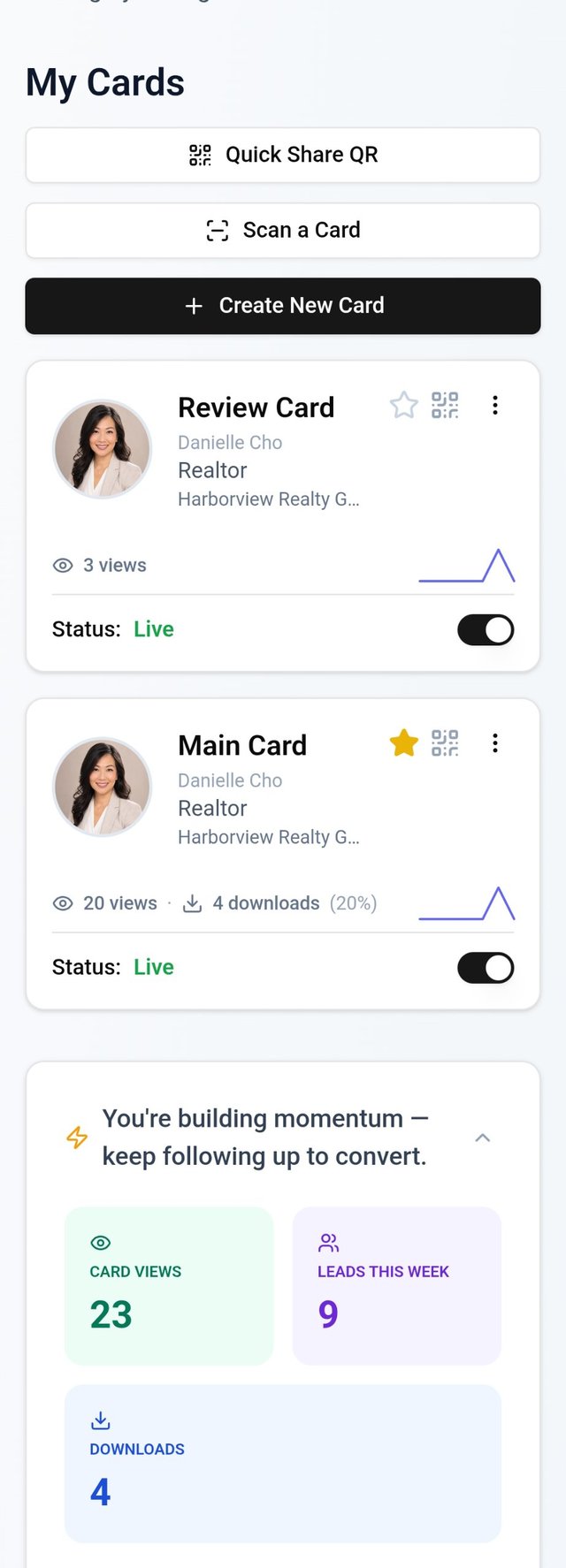
Set aside a short amount of time each month to review your lead activity. Look at more than the number of contacts collected.
Ask:
- Which sources created the most relevant conversations?
- How quickly did you follow up?
- Which messages received replies?
- Where did contacts stop moving forward?
- Which conversations led to a meeting, referral, or sale?
This review can reveal simple improvements. Maybe your form asks for too much information. Maybe your card has several calls to action and people do not know which one to choose. Maybe your follow-up is delayed because nobody owns the next step.
Use the answers to simplify the process. Better tracking is not about gathering more data. It is about making the next useful action easier to see.
The Bottom Line
A digital business card gives people a convenient way to remember and reach you. Lead tracking gives you a reliable way to remember and help them.
Record the source, conversation context, current stage, last contact date, and next step. Follow up with one relevant detail instead of a generic pitch, then review the results often enough to improve your process.
The strongest system is one you will actually use after every introduction. Keep it light, keep the context, and make the next action obvious.
What should you do?
- Best for
- Professionals who share digital business cards at events, meetings, and referrals Salespeople and service providers who need a simple lead workflow Small teams that want visibility without a complicated CRM Anyone who wants to connect card activity to real follow-up
- Use this when
- You are collecting contacts from QR scans or digital card forms You want to know which networking channels produce worthwhile conversations You often forget what to say after someone shares their details You need a repeatable handoff from introduction to follow-up
- Avoid if
- Counting scans as if every scan were a qualified lead Collecting contact details without recording the conversation context Sending the same generic message to every new contact Building a complicated tracking system nobody keeps current
- Alternatives
- [How to capture leads at networking events](/how-to-capture-leads-at-networking-events) - collect useful contact details [How to follow up after a networking event](/how-to-follow-up-after-a-networking-event) - write a better first message [Digital business cards for consultants](/digital-business-cards-for-consultants) - use one profile to support conversations
Stop letting connections go cold
My MASH Card captures who you meet, remembers the context, and helps you follow up before the opportunity disappears.


