digital-business-cards
Digital Business Cards for Coaches: Turn More Conversations Into Clients
For coaches, a lost contact is a lost client and a dent in the trust you just built. I coached financial wellbeing at Operation HOPE and collected intake on paper pads: half were illegible, numbers didn't connect, emails bounced. The ones I did reach, I had to ask to repeat what they'd already told me, which undid the session. A digital business card fixes the capture itself. People enter their own details on their own phone, answer one question about what they want help with, and your follow-up picks up where the conversation ended instead of starting over.
Digital Business Cards for Coaches: Turn More Conversations Into Clients
Coaching runs on trust, and trust is built faster than it's rebuilt.
That's why losing a contact costs a coach more than it costs most people. It isn't just a name you can't reach. It's a person who told you something personal, got a plan, and then heard nothing. Or worse, heard from you two weeks later asking them to repeat it all.
I learned that as a financial wellbeing coach at Operation HOPE, running community financial wellness workshops. People showed up wanting help with budgeting, credit, and savings. At the end of each session I'd collect intake on little paper pads. Names, phone numbers, email addresses.
I'd walk out with 30 pads and half of them were unusable. Was that a 6 or an 8? Did they write gmail or gmal? I'd call and the number wouldn't connect. I'd email and it would bounce.
What That Actually Cost
Three things, and only one of them was obvious.
I lost prospective clients. Not cold leads. People who had just spent an hour telling me they wanted help with their money. The intent was there. The contact info wasn't.
I lost trust with the ones I did reach. When the handwriting was half-legible, I'd start the follow-up by asking them to tell me again what they were working on. Small thing. But in coaching, asking someone to repeat what they already gave you says you weren't really listening. The session had built something, and that question spent it.
I made my own job harder. Fewer clients meant quota pressure, and quota pressure is felt by more than you. My managers needed numbers. Our partners needed outcomes. A stack of unreadable pads turned into a worse month for everybody, and the cause was never the coaching.
That's the part most advice about digital business cards misses. It treats capture as a convenience. For a coach it's the handoff between the session and the relationship, and that handoff is where trust either carries forward or quietly resets.
The Fix Is Who Does the Typing
A digital business card changes one thing that matters more than any design choice. The person who knows the information enters it.
They scan a QR code. They type their own email on their own phone, where autocorrect and their own fingers get it right. No handwriting, no transcription, no bounce. You walk out with contact details that work.
At Operation HOPE, that alone would have saved hours a week. No deciphering, no dead numbers, no second attempt two weeks later when the moment had passed.
Ask One Question, Not Ten
The bigger win is context. If you only capture a name and an email, you've solved delivery and not much else. You can reach them. You still don't know what they need.
Add one open field: what do you want help with?
At a workshop, that answer is where someone actually is. "Credit card debt I can't get ahead of." "Trying to buy a house in two years." "My partner and I don't talk about money." In their words, not your category.
That single field tells you more than any contact form I ever collected on paper. It also means your follow-up never has to start with the question that costs you trust. You already know. You can open with what they told you.
What a Coach's Card Needs
Keep it short, because people open it between conversations on a phone.
- Who you help, specifically. Not "coach." New managers, career changers, people rebuilding credit. A prospect should recognize themselves.
- One next step. A discovery call, a question, a resource. One. Ten links makes a decision harder, not easier.
- A little proof. One result or testimonial, not a biography.
- A short capture form. Name, email, and that one open question. Nothing you won't use.
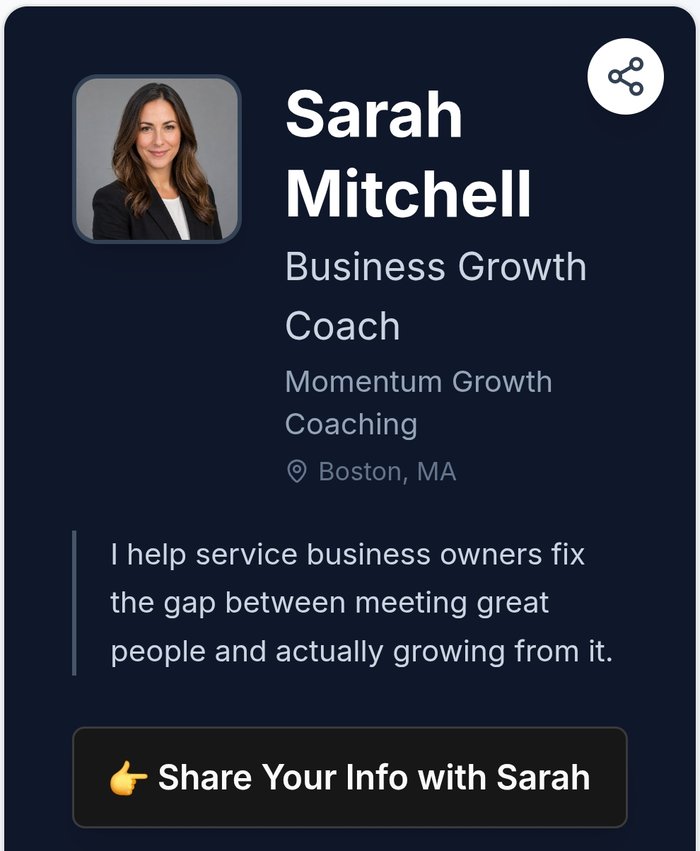
If you want the full field-by-field breakdown, what to put on a digital business card covers it.
Follow Up Like the Session Is Still Going
The card gets you a clean starting point. The follow-up is still yours to write.
Reference where you met, name the thing they told you they're working on, give one useful idea, and offer a next step without pressure. That reads like coaching continuing. A generic check-in reads like a sales sequence, and people can tell the difference immediately.
For the system behind that, how to build a follow-up system that actually works walks through the structure.
Three Mistakes That Cost Coaches Clients
Being too broad. If your card says you help everyone with everything, the right person won't see themselves in it.
Leading with credentials. Experience matters, but the first thing a prospect wants is evidence you understand their situation.
Capturing without a plan. If someone shares what they're struggling with and hears nothing for three weeks, the capture made things worse, not better. Decide when you'll respond before you collect anything.
The Bottom Line
For most professions, a lost contact is a lost opportunity. For a coach it's also a dent in the trust you just spent an hour building.
I lost clients to paper pads. I lost credibility asking people to repeat what they'd already told me. And I made my own numbers harder to hit in a job where other people were counting on them.
The fix isn't a better pen. It's letting people enter their own details, asking one real question while the conversation is fresh, and following up on what they actually said.
What should you do?
- Best for
- Executive, career, leadership, and business coaches Independent coaches who sell through referrals and conversations Coaches who host workshops, talks, or group programs Small coaching practices that need a consistent way to share information
- Use this when
- You meet potential clients through networking, workshops, referrals, or speaking events You want one current link for your coaching offer, calendar, and proof You need to capture a prospect's goals instead of relying on memory You want introductions to lead naturally toward a discovery conversation
- Avoid if
- Using a vague title without explaining who you help Sending prospects to a crowded homepage with no clear next step Asking for too much information before trust has been established Following up with a generic sales message that ignores the original conversation
- Alternatives
- [How to create a digital business card](/how-to-create-a-digital-business-card) - set up your core profile [How to capture leads at networking events](/how-to-capture-leads-at-networking-events) - collect useful prospect details [How to follow up after a networking event](/how-to-follow-up-after-a-networking-event) - continue the conversation well
Stop letting connections go cold
My MASH Card captures who you meet, remembers the context, and helps you follow up before the opportunity disappears.