
 lead-capture
How to Turn a Casual Conversation Into a Qualified Lead
Turn a casual conversation into a qualified lead by listening for a real need, offering something useful before asking for time, and capturing the context with consent. Record the problem, your promise, and one clear next step so your follow-up feels personal instead of like a generic sales pitch.
How to Turn a Casual Conversation Into a Qualified Lead
A casual conversation becomes a qualified lead when you understand what the other person is trying to solve, offer something genuinely useful, and agree on a clear next step. The goal is not to force a sales pitch into a friendly interaction. It is to make it easy for the right person to continue the conversation with enough context that neither of you has to start from zero.
I have learned this the hard way. A good conversation can feel productive in the moment and still disappear completely by the next morning if there is no useful record of who you met, what they cared about, or how you could help.
What makes a casual conversation worth following up on?
A qualified lead is not simply anyone who gives you a phone number. It is a person with a relevant problem, a reason to keep talking, and some indication that your experience, product, service, or network might be useful to them.
Listen for four signals:
- A real need. They describe a problem, goal, deadline, or change in their business.
- A relevant fit. Your work or expertise connects naturally to that need.
- A reason to act. They mention a project, event, hiring decision, move, launch, or other timing cue.
- Permission to continue. They ask a question, accept a resource, or agree to a follow-up.
You do not need all four signals before you save the contact. You do need enough context to distinguish a promising conversation from a generic connection.
How do you qualify someone without making the conversation awkward?
Ask questions that help you understand the person instead of questions that make them feel scored. The best qualification questions sound like curiosity because they are curiosity.
Try questions such as:
- "What are you focused on this quarter?"
- "How are you handling that today?"
- "What has been the hardest part of getting that working?"
- "Is that something you are solving now, or is it further out?"
- "Would it be useful if I sent you the resource I mentioned?"
The last question matters because it creates a value-first transition. You are not asking for a meeting before giving anything back. You are offering a helpful next step and letting the other person decide whether it is relevant.
Avoid turning the exchange into an interrogation. You do not need a complete sales discovery call at a coffee shop, conference table, or neighborhood event. A few thoughtful questions and a clear note are enough to decide what should happen next.
What should you do immediately after a promising conversation?
Capture the contact while the details are still fresh, then write down the reason the conversation matters. A name and email alone are not a follow-up system. "Met at event" will not remind you why you wanted to reconnect.
My preferred process is simple:
- Share a focused digital business card. Give the person one link with your contact details, relevant proof, and an easy way to continue.
- Add a short context note. Record the problem they mentioned, the resource you promised, or the introduction that could help.
- Choose a next action. That might be sending an article, making an introduction, answering a question, or scheduling a conversation.
- Set a realistic reminder. Follow up when you can be useful, not just when you want something.
My MASH Card is designed for this kind of value-first capture. You can use a QR code or link to share your card, and the follow-on interaction can preserve more context than a paper card exchange. For a deeper look at the workflow, see how digital business cards capture leads.
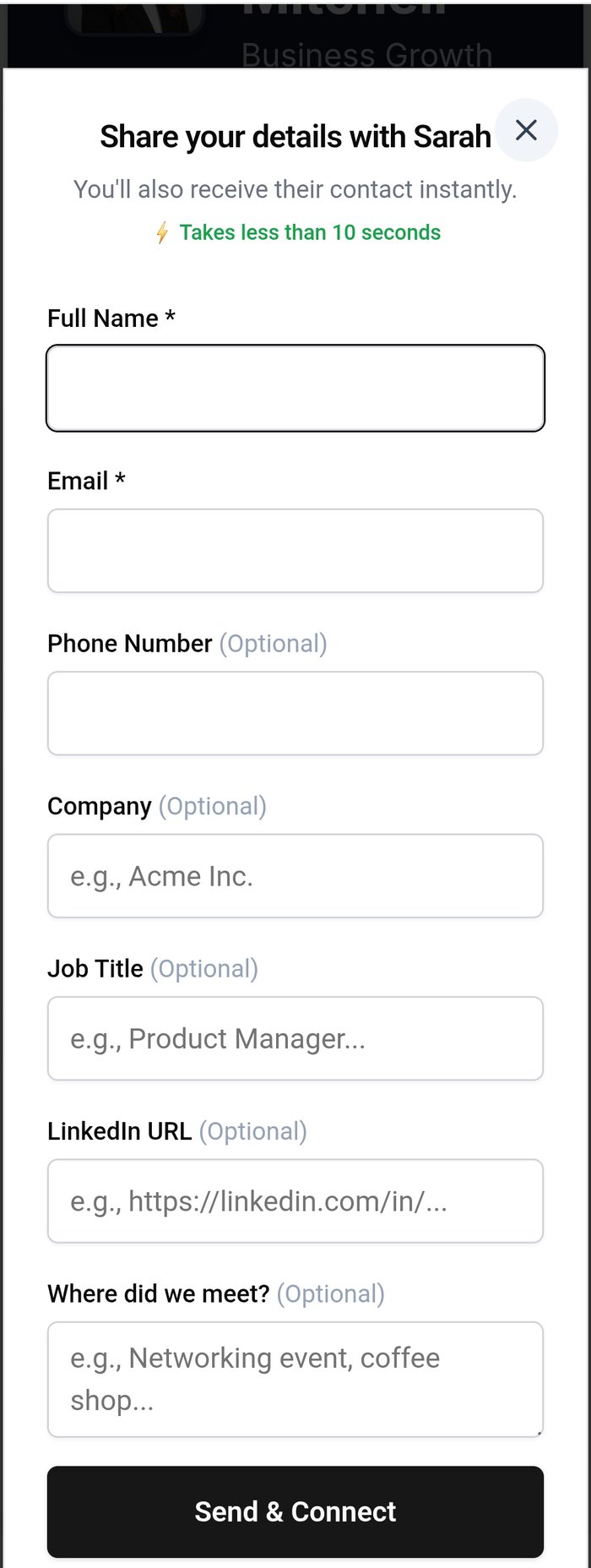
The important distinction is consent and usefulness. A person should understand why they are sharing their information and what they can expect next. A clear share-back option is much better than quietly collecting details and hoping a generic campaign will do the work later.
How do you turn a conversation into a useful lead note?
Use a note structure that captures meaning, not just activity. I like this format:
Context: Where did we meet and what was happening?
Need: What problem, goal, or question did they mention?
Fit: Why might my product, service, or network help?
Promise: What did I say I would send, explain, or introduce?
Next step: What should happen, and when?
For example: "Met Jordan at a local small-business meetup. Jordan is getting referrals from networking events but has no consistent way to capture the details. Send the lead capture guide and show how a QR card can make the next event easier. Follow up next Tuesday."
That note is specific enough to help you write a human message. It also gives you a way to decide whether the lead is active, nurture-worthy, or simply a useful professional connection.
What is the fastest way to follow up without sounding salesy?
Send the promised value first, connect it to the conversation, and make the next step optional. A strong first message might look like this:
"Hi Jordan, good talking with you at the meetup. You mentioned that event contacts often get lost before you can sort through them, so I wanted to send the lead capture guide I mentioned. The section on adding context immediately after a conversation may be useful. If you want, I can also show you the simple workflow I use."
This works because it proves you listened. It does not pretend the person requested a demo, and it does not bury the useful resource underneath a paragraph about your company.
If the person asked a specific question, answer that question before asking for time. If you offered an introduction, make the introduction. If you said you would send an example, send the example. Trust grows when your follow-up matches the promise you made in the room.
For more intentional post-event timing, learn how to follow up after a networking event. The principle is the same for a casual conversation: be specific, be useful, and make the next step easy to accept or decline.
How did I learn this from AdamHelper?
When I was running AdamHelper, customers would sometimes text me weeks after a quote. They remembered the conversation, but I did not always have a clean record of what we discussed, which option they preferred, or when they wanted to move. The gap was not a lack of interest. It was a lack of context.
I also met real estate agents through customer moves. We would trade cards and talk about possible referrals, then both of us would get busy. Without a note about the specific customer situation or the kind of referral we had in mind, the card became a reminder that we had once had a good conversation, not a bridge to a useful next step.
That experience changed how I think about lead capture. The technology is not the relationship. It is the memory layer that helps you respect the relationship. If you cannot remember what would be helpful, you are not ready to ask for another meeting.
Can a digital business card qualify leads by itself?
No. A digital business card can make sharing and capturing information easier, but qualification still comes from the conversation and the quality of your notes. The card should support good listening, not replace it.
Different tools approach this in different ways. Linq, HiHello, Popl, and Blinq can all help professionals share contact information digitally, but a useful lead process depends on more than the card surface. Look at how easily you can present the right information, capture consent, preserve context, and follow through without creating friction.
A card with every possible link is not automatically better. For a casual conversation, send the page or profile that supports the topic you were discussing. Someone asking about referrals may need a proof point or service page. Someone exploring a partnership may need your work samples and an easy way to contact you. Relevance makes the interaction feel personal.
What should you avoid when qualifying a casual conversation?
Avoid these common mistakes:
- Treating every contact as a hot lead. Some conversations are valuable relationships without an immediate buying signal.
- Sending a generic pitch. If the message could go to anyone, it probably will not feel worth replying to.
- Collecting information without explaining why. People deserve clarity about what happens after they share their details.
- Waiting until you have a perfect offer. A useful article, introduction, answer, or example can be a better first step than a polished pitch.
- Writing vague notes. "Follow up sometime" is not an action. Record the topic and the next useful move.
- Overpromising. Only offer what you can actually deliver, then deliver it when you said you would.
The best lead capture process is respectful because it helps both people remember the conversation accurately.
When should you move from a casual conversation to a sales conversation?
Move forward when the other person confirms that the problem matters, understands why your solution may fit, and shows interest in a specific next step. That could be a short call, a walkthrough, a quote, or an introduction to someone who can make the decision.
You do not have to force that transition in the first interaction. A qualified lead can be qualified for a future conversation. If the timing is wrong but the need is real, record the timing and send something useful now. A thoughtful message in three months is better than a rushed pitch today.
The strongest networkers I know are not the people who collect the most contacts. They are the people who remember what others are working on and show up with something useful. A digital business card helps, but the real conversion occurs when your follow-up proves that you were paying attention.
Final takeaway
Turn a casual conversation into a qualified lead by listening for a real need, offering value before asking for time, capturing context with consent, and choosing one clear next step. A contact becomes worth pursuing when you know how you can be useful and have permission to continue the conversation.
That is the standard I try to bring to every introduction now. Do not chase a name. Remember a person, solve a small part of the problem, and make the next useful interaction easy.
What should you do?
- Best for
- Professionals, service businesses, consultants, and networking teams that want to turn real conversations into respectful, context-rich follow-up.
- Use this when
- Use this process after a conversation reveals a relevant problem, goal, or upcoming decision and the person agrees to continue the interaction.
- Avoid if
- Avoid generic pitches, vague notes, collecting contact details without clarity, and treating every new connection as a hot lead.
- Alternatives
- If there is no immediate buying signal, treat the person as a relationship to nurture by sending a useful resource, making an introduction, or answering their question.
Stop letting connections go cold
My MASH Card captures who you meet, remembers the context, and helps you follow up before the opportunity disappears.


