
 industry
Digital Business Cards for Event Professionals and Conference Goers
Event professionals should use a digital business card to capture contacts with context: tag each person by event, save a one-line note about the conversation, and follow up within 24 to 48 hours with something useful rather than a pitch. A QR code or link makes sharing fast in a crowded room, and organized notes with reminders are what turn a busy event into conversations that continue.
Digital Business Cards for Event Professionals and Conference Goers
Events create a strange kind of abundance. In one conference day you can meet more people than you would in a normal month at the office, and most of them genuinely want to stay in touch. The problem is what happens after. By the time you are back at your hotel, half the conversations already feel interchangeable. By the time you are home, most of them are gone. A digital business card with lead capture gives you a way to hold onto those conversations.
I learned this while covering a 40th birthday party in Brookline with a DSLR. I was there to shoot the event, moving constantly, trying not to miss moments. Between shots, people wanted to talk: vendors, guests, the venue coordinator. I wanted to stay in touch, but there was no time for a full conversation or a careful contact exchange without missing the next shot. A paper card slid out of my pocket was the fastest thing I had. When I tried to follow up later, I had a few names, no context, and no idea what any of those people actually wanted. The event went well. The follow-up was a mess.
That gap between a good event and a good follow-up is exactly where a digital business card earns its keep. The card is not the trick. The trick is capturing the context while you are still standing in the room, and having a system that reminds you to use it.
Why do paper cards fail at events and conferences?
Paper fails at events for a reason that has nothing to do with the card. Events create volume and remove time. You meet people between sessions, in hallway conversations, at the booth next to yours, in line for coffee. Nobody pauses to write down what you discussed. The card lands in a pocket next to four others, or in a swag bag under a stack of brochures.
A week later you have a pile of cards and no memory of which person asked about your pricing, which one wanted an introduction, and which one was simply being polite. That is the real loss. The contact details were never the valuable part of the exchange. The conversation was, and paper throws it away.
What should event professionals capture instead of contact info?
Capture context, not just a name. At a minimum, four things:
- An event tag, so you know where you met
- A one-line note about what the person cares about or asked
- The next step you promised, if you promised one
- Their preferred way to be contacted
The difference is easy to feel. "John, marketing" is a dead end. "John, runs marketing for a venue company, asked how we handle multi-day event follow-up, sending the checklist Thursday" is a follow-up system in one sentence. You do not need a paragraph per contact. One honest line is enough to make your first message personal and useful.
If you want a fuller framework for what to record in the moment, see how to capture leads at networking events.
How do you share your card quickly in a crowded room?
With a QR code or a link. My MASH Card supports QR code and link sharing, not NFC hardware, which keeps things simple: the person scans or taps, your card opens, and the exchange takes seconds even in a loud hallway between sessions.
But the share is only half of it. If someone scans your card and you both walk away with nothing but a URL, you have recreated the paper problem in digital form. The scan should trigger your one-line note while the conversation is still fresh in your mind. Share fast, then capture the context that made the conversation worth having.
How do you organize event contacts so they do not blur together?
Organization is what saves you from the Brookline problem. Tag every contact by the event where you met them, and the pile turns into segments you can actually work.
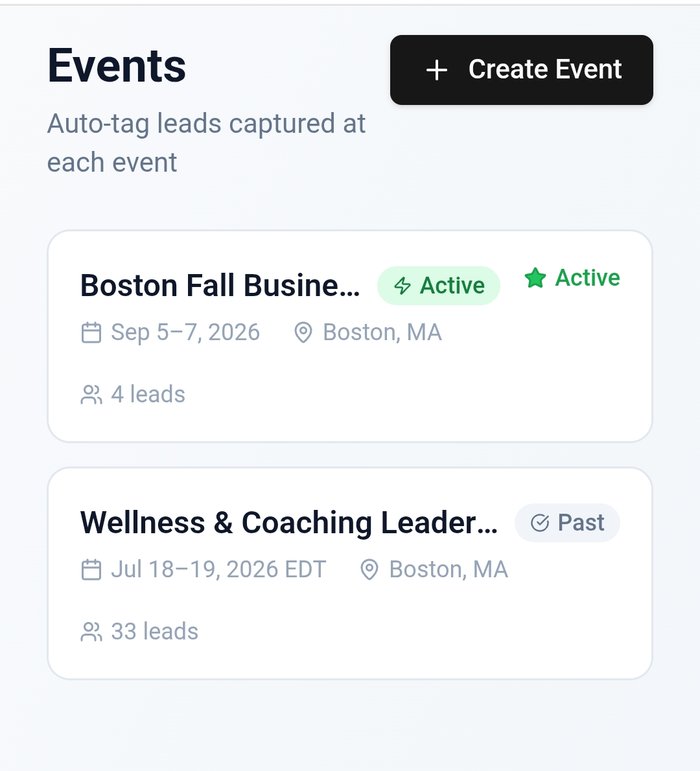
The screenshot above shows the events view in My MASH Card: each event becomes its own bucket, and the contacts inside it stay grouped by where you actually met them. When you sit down to follow up, you are not staring at one giant list. You are working one event at a time, with the context still attached.
This also makes events comparable. If the September conference produced twelve contacts with real notes and the October mixer produced forty scans with none, you have learned something about where your best conversations actually happen.
How do you follow up with conference contacts without being salesy?
The same way you should follow up anywhere: lead with value, respect their time, and skip the fluff. Send your first message within 24 to 48 hours while the event is still memorable. Before you ask for anything, give something: the resource you promised, an introduction, an honest answer to the question they asked at the booth.
Every message should earn its place in their inbox. If it can be summarized as "just checking in," delete it and send something that helps instead. Event follow-up is where most professionals quietly reveal whether they see people as humans or as scans, and people can tell the difference.
For a fuller framework, see how to follow up after a networking event. The short version: be the person who followed through on the interesting conversation, not the person who added another name to a blast list.
What should speakers, exhibitors, and vendors do differently?
If you are speaking, people will come to you, which means selective capture matters more than volume. When someone scans your card after your talk, note which talk it was and what they asked about, because your follow-up will land better when it references their actual question.
If you are exhibiting or vending, you have the opposite problem: volume. Badge scans and booth conversations can stack up fast, and the temptation is to dump them all into one generic email. That is how a good event becomes spam. Industry data from ZoomInfo suggests most sales require five or more follow-ups, yet many people stop after the first attempt, and the ones who stop usually stop because they never knew what to say next. Context notes are what give you something to say.
How do you know whether an event was worth it?
Count what actually happened, not what you collected:
- How many contacts have a real note attached
- How many received a personal follow-up within 48 hours
- How many replied, booked a conversation, or made a referral
- Which events produced the conversations that went somewhere
A stack of scans is not a result. Conversations that continued are. If you want a deeper method for tying capture to outcomes, see how to track digital business card leads.
Is a digital business card worth it for event professionals?
Yes, with one condition: you have to use it as a system, not a novelty. The card gets you a fast share in a crowded room. The notes, event tags, and reminders are what turn that share into relationships that survive the trip home.
If you are comparing options, Linq, HiHello, Popl, and Blinq all approach digital contact sharing with different strengths. Compare the whole workflow, not just the card design: can you tag contacts by event, keep a note on each conversation, and get reminders that keep your follow-up human? My MASH Card is built exactly around that loop: it follows up with you, nudging you to act with the context you captured, rather than sending generic messages on your behalf.
If you mostly attend casual events, the free plan is enough to capture and organize contacts. If you are working events for revenue, as an exhibitor, vendor, speaker, or organizer, the Pro plan adds the follow-up system that turns one weekend into months of pipeline. You can compare both on the pricing page.
Events will keep happening. The professionals who get the most from them are not the ones who meet the most people. They are the ones who leave with context and follow through with something useful.
What should you do?
- Best for
- Event professionals, exhibitors, speakers, vendors, and regular conference goers who want organized, tagged contacts and a follow-up system that reminds them to act.
- Use this when
- You attend or work conferences, trade shows, panels, or community events where you meet more people than you can remember, and you want every conversation to have a next step.
- Avoid if
- Collecting scans with no context notes, dumping every contact into a blast email, and assuming hardware is required. My MASH Card works with QR codes and links only.
- Alternatives
- Linq, HiHello, Popl, and Blinq each handle digital contact sharing. Compare the full workflow, not just the card: can you tag contacts by event, keep notes, and get follow-up reminders that keep you human rather than automated?
Tags
Stop letting connections go cold
My MASH Card captures who you meet, remembers the context, and helps you follow up before the opportunity disappears.


