
 comparisons
Free Digital Business Card: Is It Worth It?
A free digital business card is worth it when you mainly need a professional contact page and an easy way to share your information. It becomes less useful when you need organized lead capture, context from conversations, follow-up reminders, templates, analytics, or a workflow your business can rely on.
Free Digital Business Card: Is It Worth It?
A free digital business card is worth it if your immediate goal is simple: give people one professional link where they can see your information and save your contact details. It is a practical way to stop handing out paper cards, test digital sharing, or create a basic online presence without adding another monthly expense.
The important question is not whether free is good or bad. It is whether the free version solves the problem you actually have. If you only need a clean profile and a link or QR code, free may be enough. If you meet a lot of people and need to remember who they are, what you discussed, and when to follow up, the value is in the workflow around the card, not just the card itself.
What does a free digital business card usually include?
Most free digital business card plans are designed to get you started. You can typically create a profile with your name, photo, job title, company, phone number, email address, website, and social links. Many services also provide a shareable URL and a QR code.
That is already useful. Instead of saying, "I will send you my information later," you can share one link while the conversation is still fresh. The other person can open it on their phone, save your contact details, and choose the next action without waiting for you to find a card or type out a message.
Free plans may also let you change basic profile details, add a logo, or choose from a few layouts. The limits usually appear when you want deeper customization or want the card to support a repeatable sales and networking process.
Is a free digital business card better than a paper card?
For many professionals, yes. A digital card is easier to update, harder to lose, and capable of doing more than displaying static information. You can change a phone number or website once instead of reprinting a stack of cards. You can also include links that take someone directly to a booking page, portfolio, social profile, or lead form.
Paper still has a place. Some people prefer a physical card, some events have poor connectivity, and not everyone wants to scan a QR code. A paper card can also be useful as a backup. But paper is a weak system for remembering context. Once someone puts it in a pocket, there is no built-in record of where you met or what you planned to discuss.
That is the gap a digital card can begin to close. It gives the person a useful destination, and it gives you a chance to make the next step easier.
When is free actually enough?
Free is enough when your networking volume is low and your requirements are straightforward. A free card can be a good fit if you are:
- A student or job seeker sharing contact details at occasional events
- A freelancer who needs a simple profile, portfolio, and booking link
- A solo professional replacing an outdated paper card
- A small business owner testing whether digital sharing feels natural
In those cases, paying for advanced features before you know what you need can be unnecessary. Start with the basics. Make sure your profile is clear, your links work, and your contact information is easy to save.
A free plan is also useful as a trial. Use it at a few real conversations instead of judging it from a feature list. Notice what happens after the exchange. Did the person save your information? Did you remember to follow up? Did you have enough context to write a relevant message? Those answers tell you more than a pricing page.
When does a free plan start to feel limiting?
The free plan starts to feel limiting when you are using your card as part of a real relationship-building process. A profile page can share information, but it does not automatically help you manage the relationship afterward.
Look closely at limits around contact capture, notes, tags, templates, reminders, analytics, exports, branding, and the number of cards or users included. Some plans may allow unlimited sharing but provide little help after a person visits your page. Others may put important customization or tracking features behind a paid tier.
This matters because the most expensive part of networking is often not the card. It is the missed opportunity that follows. If you meet someone who could become a client or referral partner and then forget the conversation, a free card did not really solve the full problem.
A few years ago I did media work covering a 40th birthday party event in Brookline. I was the one with the DSLR, moving through the party and capturing moments that only happen once.
That kind of work is not traditional networking. You are not standing still having a full one-on-one conversation where you can comfortably pull out your phone and let someone scan your QR code. You are working, and the moment you spend lining up a scan can be the moment you miss the shot.
That night, a paper card was genuinely useful. When someone asked how to reach me, I could slide a card out of my pocket, pass it over, and keep shooting. No app to open, no screen to wake up, no interruption to the work.
At the time I did not have MY MASH Card. I was using another competitor, and it was fine for a basic profile, but it did not offer a business card template the way MY MASH Card does, so I could not tailor a second card to that kind of situation.
If I covered a similar event today, I would set it up differently. I would keep my regular personal card ready for the moments when a real conversation does happen. I would also create a business card for the event and print its QR code on a flyer or a small brochure, so people I barely had time to talk to could still find me afterward. Another option is to put the QR code of my personal card onto an actual paper card. The card still works in the moment, and the QR code quietly turns it into a lead capture tool: an easier way for someone to get your full information after the paper changes hands.
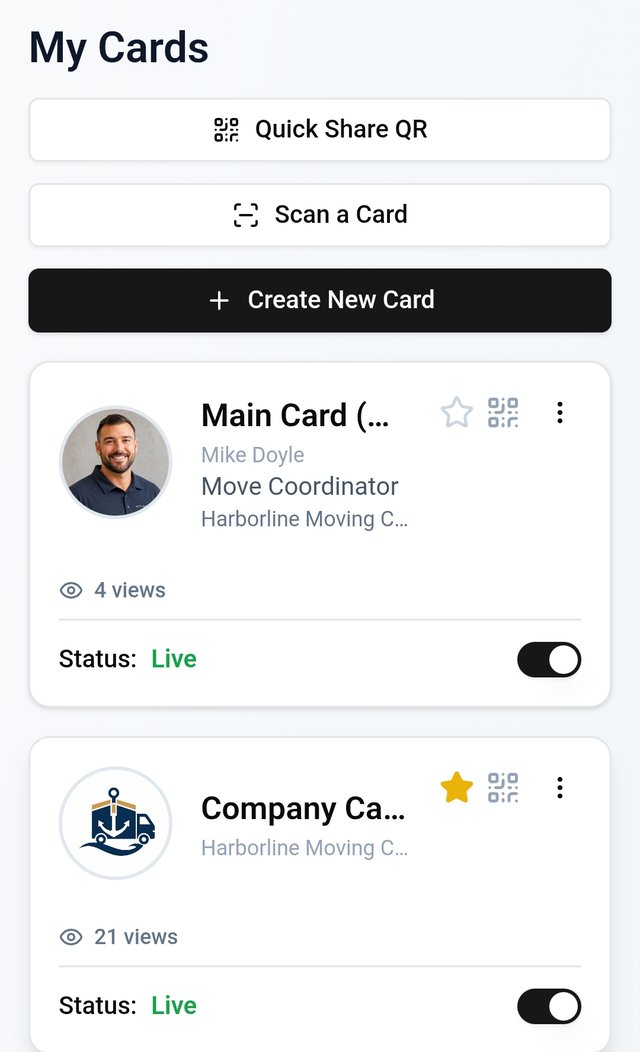
One thing to know: a business card and a personal card cannot be used under the same plan, so if you want both, you need to upgrade to the Pro plan. That is exactly the kind of situation where free stops being enough. Not because free is bad, but because the way you work has outgrown a single profile page.
What did I learn from running trade show booths?
When I ran trade show booths for HapYak, a SaaS video platform, electronic scanners made it easy to collect leads. The problem was that the scanner often captured a person without capturing the useful context around the conversation.
A list of names and email addresses is not the same thing as a list of relationships. After a busy event, I might remember that someone was interested in a particular use case, wanted an introduction, or asked me to send an example. Without that context attached to the lead, follow-up became harder and more generic.
That experience changed how I think about digital business cards. The free sharing part is helpful, but the real value comes from what happens after the scan. I would rather have a smaller list with a note about the conversation than a large list of contacts I cannot place.
How do free plans compare with paid digital business card tools?
Free and paid tools are not always separated by whether the card looks professional. A free card can look perfectly good. The difference is more often in control and follow-through.
A paid plan may offer more profile customization, branded domains, lead forms, analytics, contact organization, multiple cards, team administration, or integrations. Those features matter more when you share your card frequently, represent a company, or need to measure what happens after someone visits your page.
Competitors take different approaches. Linq and Blinq are known for digital card experiences that emphasize sharing and profile presentation. HiHello offers tools aimed at professionals and teams. Popl is often associated with digital networking and lead capture. The right comparison is not just which card has the nicest design. Ask whether the tool fits the way you meet people and follow up.
MASH Card is built around the same practical question: what happens after someone receives your information? It supports QR code and link sharing, not NFC hardware, and the broader value is connecting a digital card with lead capture and follow-up habits.
You can also compare a free tool with a simple digital business card setup guide, then decide whether you need more than a profile page. If your main concern is losing people after an event, review how to capture leads at networking events and how to build a follow-up system.
To compare the hard costs of paper cards against a free or paid digital card side by side, try our digital business card ROI calculator.
What should you check before choosing a free plan?
Before signing up, test the parts that affect real use:
- Sharing: Can you share a short link and QR code quickly from your phone?
- Contact saving: Can the recipient save your details without friction?
- Editing: Can you update your information without rebuilding the card?
- Branding: Does the free version put another company's branding in a distracting place?
- Lead capture: Can you collect useful information, or does the card only display your details?
- Follow-up: Can you add notes, tags, templates, or reminders when you need them?
- Ownership: Can you export or manage your contacts if you change tools later?
A free plan that handles the first three may be enough for basic sharing. A free plan that handles all seven is much more valuable for someone who networks regularly.
How can you get more value from a free digital card?
Treat the card as the beginning of the conversation, not the end. Put one clear next step on the page. That might be booking a call, viewing your work, joining a newsletter, requesting a quote, or sending you a message.
Then create a simple personal habit. Immediately after a meaningful conversation, write down the person's name, where you met, the topic you discussed, and the next step. You can do this in a notes app or contact system while the details are fresh. Later, send a message that proves you remember the interaction.
Your card should also match the context. A consultant might lead with a calendar link. A contractor might make it easy to request an estimate. A coach might feature a discovery call. The best card is not the one with the most links. It is the one that makes the next useful action obvious.
So, should you use a free digital business card?
Yes, start free if you want to replace paper, test digital sharing, or create a straightforward professional profile. There is no reason to pay for a large feature set you will not use.
Move beyond free when your card becomes part of a consistent process for capturing leads, organizing contacts, preserving conversation context, and following up. At that point, the question is not whether the subscription costs money. The question is whether the system helps you avoid missed opportunities and makes good follow-up easier.
A free digital business card can be a smart first step. Just do not confuse a free profile with a complete networking system. The card gets the information across. Your process is what turns a new connection into a relationship.
What should you do?
- Best for
- Solo professionals, students, job seekers, and small business owners who want to start sharing digitally without committing to a subscription.
- Use this when
- Use a free digital business card to test digital sharing, replace a paper card, or give a new professional a simple online contact page.
- Avoid if
- Avoid choosing a free plan based only on the word free. Check whether it limits your branding, contact capture, edits, analytics, exports, or follow-up tools.
- Alternatives
- Use a paper card for audiences that are not comfortable scanning or opening links, and consider a paid plan when your team needs shared controls, analytics, or more advanced follow-up workflows.
Tags
Stop letting connections go cold
My MASH Card captures who you meet, remembers the context, and helps you follow up before the opportunity disappears.


